Monday, May 20, 2019

Is Paris Burning?

Photo by Maxime Naillon on Unsplash

On April 15th, the world was stunned with the fire news that toppled the Paris landmark Notre Dame Cathedral spire before the firefighters contained the blaze. I immediately thought of the excellent postwar movie "Is Paris Burning" to tell how and why Paris was saved from Hitler's order for its destruction.  In no time President Macron pledged to rebuild it at whatever cost.

The Cathedral was built in medieval days, ground breaking from 1163 to completion of 1345. It was equivalent to the Kamakura Shogunate days in Japan where temples of Zen Buddhism flourished.

Over 850 years, the Cathedral has seen coronations, French kings and Napoleon, trial of Joan of Arc, revolution, occupation, liberation, violent religious upheavals, terrorism, pollution, etc.

The aging decay of the cathedral was intolerable to Victor Hugo. He raged "As much beauty as it may retain in its old age, it is not easy to repress a sigh, to restrain our anger, when we mark the countless defacements and mutilations to which men and time have subjected our venerable monument."  His 1833 novel The Hunchback of Notre Dame was his great rescue effort.

Found a poem written by Kotaro Takayama (1883-1956) who frequented while staying in Paris. I translated his poem for tonight. This is based on my “gut” translation and is not truly literal.

"Oh Nortre Dame!  Notre Dame!
Are you a  monolith?  A reigning eagle?  A crouching lion?
Or a celestial submerged rock?
Whatever you are, you are surely a grandiose Square Pillar of Paris.

Facing eye-blinding fusillades of rain drops
hand-beaten with strong wind
I"m narrowly looking up at soaring Notre Dame de Paris
with my rainy weather eyes
I'm a Japanese visitor

My mind is trembling in awe just looking up at you
Having observed your tragic but brave drama!
My foreigner's heart was shaken with beats and shivering in echo with
the pandemonium uproar!"

Friday, May 3, 2019

Essay Awards Ceremony Memories

The "Heisei" era lasted for 30 years to be replaced by "Reiwa" in a few days with Crown Prince Naruhito succeeding as Emperor. My retirement in the U.S. and homecoming to Japan was unforgettably remembered in the year 1995 of the Great Kobe Earthquake, which was the 7th year of Heisei. It means I have been back in Japan now for 23 years.

Japan surprised me with frequent earthquakes and flash floods, the impermissible crime sarin gas attack on the Tokyo subway by a religious cult, the sudden bankruptcy of Yamaichi Securities Trading with 200 billion Yen debts,  and the ensuing deflationary economic trend and unusually prolonged stagnation plaintively dubbed the "Lost 20 Years". I remembered my American friend's question, "Why are you heading back to Japan?"

Here I am in disaster-prone Japan, getting older each day, relearning living is getting old. Late last year, I saw Kitakyushu City inviting submission of essays for the first time from those who celebrate 88 years by the end of November, in addition to the annual novel, poem and Haiku.  I decided to apply, writing about my life after the homecoming.   Around mid-January, I was notified that my essay was selected as prize worthy by the committee with an invitation to the ceremony at Otani Keikan Hall in Yawata on March 24. The award winning writings were collected in a publication called Hibiki.

The day came.  I was accompanied by my son who happened to be visiting from New York City.  About 30 prize winners for various categories from all over Japan attended with their friends and families at the ceremony.   Of the said essay category by “eighty-eighters”, three were Kitakyushuans, two from Sendai and Nagano.  Ms. Minako Goto, President of Kitakyushu Association of Literature gave out certificates of awards to all the winners. The Chair of the ceremony was Ms. Tae Wakasugi.  A celebratory banquet followed, with various entertainment (some by the award winners), attended by Kitakyushu Mayor Kitahashi and Ms. Imagawa of Kitakyushu Museum of Literature.  I was lucky enough to thank Mayor Kitahashi in person for his gift of money for my "Beiju" celebration.

The event was held at Otani Kaikan Hall with symmetrical Art Deco style architecture, built in 1927.  The building was then owned by Yawata Steel Works, but it is now open to the public.   It received the Kitakyushu City Architectural Culture Award in 1989 and was registered as a modern architectural heritage in 2007.  My memory is still fresh also, as the site of dining with the Moes before building Kitakyushu Toastmasters Club.

P.S. - Coming soon!  I am printing a small booklet of my prize winning essay, both in Japanese and English, of about 20 pages plus.

Sunday, April 28, 2019

Of Mice and Men

But Mousie, thou art no thy lane,
In proving foresight may be vain;
The best-laid schemes o' mice an' men
Gang aft agley,
An' lea'e us nought but grief an' pain,
For promis'd joy ! 
- "To a Mouse"  by Robert Burns 

Another ski season!  George, my best friend in Pardubice, Republic of Czech, sent me his recent Toastmaster speech, titled “Of Mice & Men”, my favorite novella and play by John Steinbeck.  I featured him in my blog “Silver Iron”, a top skier in the authentic Orlicky Half Marathon Cross Country (XC) event in 2012.  

His venture this time, he fell more than once in the Hervis Jizerske 25, completing a circular loop, both thousand meter level ascending and descending trail.  I asked him about snow conditions and he answered it was perfect. Sounded like the trails were overcrowded with fellow racers, which brings me to the Burns poem. Anything can happen suddenly to upset your expectations, however perfect a plan you have made.  I wrote to George “But You made it!  Bearing pains and cramps.”  Steinbeck quoted Burns poem and used it as a title of his novella. 

Krkonose!  The top Czech mountains and National Park in northern Bohemia and the source of River Elbe, bordering  Poland. George told me about Giant Krakonos (Rubezahl in German) that inhabits and tricks men in a friendly manner, symbolized in wooden carved statutes along the mountain paths.  I loved the sound of Krkonose. It must be a lovely summer resort as well.  The town Nachod, the birthplace of Jan Letzel, the architect of the Hiroshima Dome, sits at its foot.  I visited the Jan Letzel College of Architecture accompanied by Toastmaster George in 2005.

I have loved both Burns and Steinbeck ever since I was a student.  While traveling in Mexico after retirement, I met a woman who was completing Burns’ works. When I visited her house in Los Angeles, she showed me part of her research papers before she died. Regarding Steinbeck, I had visited his Salinas home a long time ago. I also visited the National Steinbeck Museum built in 1998 in Salinas. Traveling to Monterey, California on business, I took the time to visit Cannery Row to Fishermen’s Wharf.  Both literary giants have inspired me greatly.

George also seems enjoying running with friends to keep him physically fit for winter sports, the source of his stamina.  Go-go-go George! 


Of Mice and Men
by Jiri Pscenicka

My dear toastmaster friends. Some of you may remember that about a month ago Eda and I took part in Orlicky Half Marathon. A cross country-skiing race on a windy day and in a bit tricky snow conditions. Well we both had falls there, traces of which remained for some time on our faces. Perhaps some of you said: „Is it wise for men of their age to do such things? Well, George is an old fool, but Eda is a respectable doctor, he should know better!“ Our answer would be: But we LOVE cross-country skiing!“

My next love affair with cross-country skiing happened just 6 days later. Hervis Jizerská 25, a race in which I took part a year ago. I considered the race in the Jizerské Mountains much easier than the Orlický half-marathon. So my expectations were high. Last year I was too shy, I started almost from the end of the field and I overtook many skiers during the race. I finished even in the first half of result list (which never happened to me in the Orlický marathon), so this year I planned to start from the front. „More assertivity, George!“ I said to myself.

To prove my assertivity I placed my skis in the fifth row from the front. And OFF we went! Well, my first impressions from the race were promising. I was not overtaken by many people and when we came to the first uphill part, I said to myself:“ Jolly good show, George! Your choice of ski-wax was good“. Some people were sliding backwards, some already had to use herringbone, but my Silver Swix Klistered skis slided beautifully up the hill!  So, full of hope, I eagerly moved forward. But on the 3rd km it happened. A girl fell right in front of me! And when I was avoiding her, I fell too. I managed to get up quite soon. But I felt an excruciating pain in the back of my left thigh. „ Oh dear, it must be spasm! I went to the right side of the track trying to massage it. It did not help. So I limped very slowly forward cursing myself that I had forgotten to take with me Nutrend Magnes Life solution which is supposed to help against spasm immediately.

On the 5th km there was the first refreshing station. I drank ion drink there and asked the volunteers: „Have you got something with magnesium? I have a terrible spasm in my left thigh!“ They did not, but they offered me kitchen salt instead which should also help. A girl brought it in a big open box. I grabbed it in my left glove and put it in my mouth. Ugh! A terrible taste. But I was too shy to spit it out, so I went on. And then I said to myself: „George, you old fool, you should have taken salt first and then the drink!“ I salivated profusely for the next 10 km to the second refreshment station to get rid of the unpleasant feeling in my mouth. And there I asked: „Just the drink, no salt, please!“ 

After the fall my ordeal was to limp for 22 km to the finish. I moved a bit like Vladka on her scooter. The weight of my body was mainly on the right leg, the left one was flapping behind. Luckily, I had two ski poles and two arms to push me forward. And also, the circuit of 25 km race was oriented in anti-clockwise direction, which meant that most bends were to the left, when the body weight is on the right ski. But crowds of people were now overtaking me. At the start we had a snowfall, but later the sky cleared up and the sun was shining! From the upper parts of the course between Čihadla and Hřebínek we could see rolling hills down below. „Po modrém blankytu bělavé páry hynou, lehounký větřík s nimi hraje!“ (* See translation below), I recited loudly to other skiers. But nobody was interested in poetry. They just panted heavily overtaking me. (Well, if they were Germans, Swedes or Norvegians, that might be an excuse.) I noticed one thing which made me afraid: A lot of girls kept falling even in very easy downhill parts. They usually screamed, threw about their arms and fell on their buttocks. At one time I saw three of them on the ground and had to do slalom to avoid them. Well, there was only one sharp bend to the right before the finish. And I fell there, as could have been expected. But I got up quite quickly and finished the race. A girl at the finish slipped a ribbon with a massive glass medal round my neck. But I was unable to loosen binding on my left ski. Somebody had to do it for me.

Now you must be thinking: „Did old George also hit his head apart from his buttocks in the race? Why did he call his speech „Of Mice and Men“, when he talks about skiing?“ Well, it is purely for educational purposes.  „Of Mice and Men“  is a novella by American author John Steinbeck. But he himself was inspired by a poem „To a Mouse“ by the Scottish bard Robbie Burns. In it he says: „The best laid schemes of mice and men often go awry.“ That’s exactly what happened to me! Expecting triumph I met with disaster! Great Expectations gone with the wind! 

Oh, George, don’t be so hysterically histrionic! Your fall was not a disaster, it was just a minor mishap! No broken bones. You were able to finish the race. You should be grateful to God for getting away so easily. Yes, I am grateful to God for that, I know I might have finished much worse off. And here is the question again: „Was it worth it?“ My answer is: „Yes, it was. I love cross-country skiing.“


* In his speech, George recited Karel Hynek Macha (1810 - 1836), Czech's romantic poet in his native language (I took as his curse). This poet was a young judge. I asked the meaning in English. He gave me the following answer.

"In the azure vault of heaven the blanching mist are dancing. In light dissolving zephyrs tattered,
And on the far horizon scattered white cloudlets over the placid sky go glancing."

Saturday, April 20, 2019

Chapultepec Park, Mexico

Anyone recall Mexico Olympic 1968, the year the Japanese women's volleyball team lost the Gold Medal to the Russians; the expression ”Wonder Women from the Orient” became popular?

My first visit to Mexico City was 1958, and my stay was for one month. There was an Industrial Fair and I was to sent to man the show booth and President Lopez Mateos (48th) dropped by. There was no subway running then. The subway opened almost with the 1968 Olympic. I used un-peso coche to commute to and from my hotel and the Fair venue at Chapultepec Park.  Anyone could share a taxi just pointing the finger up and the fare was just one peso along the Paseo Reforma.

The 700 acre (cf. 850 New York Central Park) Chapultepec is full of lush, sprawling green trees, serving as the city lungs that replenish oxygen to the citizens. 

Chapultepec means grasshopper’s hill in Spanish. The summer house built for the Spanish Viceroy in early 1800 served as a military academy, then became a Castle, later designated as the UNESCO World Heritage site.  Short-lived were Emperor Maximilian, brother of the powerful Franz Joseph, Austrian Emperor, King of Hungary, resided here with Empress Carlota.  Why was Maximilian in Mexico after the Mexicans chased out the Spaniards?  Because of  French intervention. Mexico borrowed money from Europe, England, France and Spain to achieve independence. Strapped for funds and having to pay interest, Mexico asked for a moratorium, to which Napoleon III refused, then invaded Mexico. I opened a history book and found there was a call for a return to monarchism in Mexico.  France accepted the moratorium with the condition that Ferdinand Maximillian be accepted as Emperor. After his downfall, Maximillian could have gone home, but he stayed and was shot to death. His last words, Viva Mexico, Viva Independence.

Maximillian's accomplishments while he was in Mexico include building Paseo de la Reforma just like Champ-Elysees in Paris, and preserving serene Jardin Boda in Cuernavaca, 30 km west of Ciudad de Mexico. He had a special interest in botany.  

Sunday, January 27, 2019

A History of Sweets

Have a sweet tooth?  Listen up!

My speech I gave at Toastmaster's recently was about the history of sweets, favorite things to many, I'm sure. Relax in your chair and enjoy.  Maybe even close your eyes.

Before Christopher Columbus, the world didn't know anything about chocolates - such a delicious treat didn't exist.  It was Hernandez Cortez, the Spanish Conquistador, who introduced it, borrowing the name from the language of the Aztecs, Nahuatl, "xocolatl".  This word is built on xococ "bitter", a drink made by a sugar free people from Cacao, itself from Naguato cacauatl "cacao".  Similar Aztec words are avocado, coyote (wild animal, smuggler), tecolate, chipotle. Chipotle is the top California Mexican grill.

Now let us review the Mayan myth a little bit. God was creating the world to be fair and well-balanced:

Give country A a vast land but, be harsh in climate.

Country B is small - let's compensate it with delicacies from land and sea.

Now comes Mexico. Fairly good sized but mostly desert and hot. God said OK, leave it as is....  God heard a shadow voice. "It's a pity to leave it as is. Can you add something?"  So God sent Quetzalcoatl to check it out. He brought many goodies to Mexicans: corn, cotton, and cacao in particular, my subject tonight.  But this benefactor god, disguised as a feathered serpent, vanished suddenly.

Cortez, Spaniard I mentioned above, landed in 1519, the year Quetzalcoatl was believed to return. Cortez faced no resistance. Instead, Cortez was welcomed by Montezuma, a Mayan Emperor. Montezuma served Cortez in golden goblets, a "Theobroma" ritual.  In Greek, theobroma means food from God.  Cortez found it bitter, and did not find it to his taste. However, Montezuma reportedly drank 50 chocoatl a day. To make the concoction more agreeable, Cortez and his countrymen added vanilla and other miscellaneous ingredients.

The Spaniards took chocolatl to Europe.  It gave a sudden rise to all kinds of confectioneries and world enterprises. After many centuries, companies like Hershey, Godiva, Nestle, See's, Mars, Kinder, and Dove survived, just to mention a few. I'm sure you know them well.

Many thank Cortez for adding tasty pleasures, tickling our taste buds and giving us moments of sweetness. Today’s talk was just a tasty slice of history.

Monday, January 21, 2019

Beethoven’s Ninth Symphony

Freude, schöner Götterfunken,
Tochter aus Elysium,
Wir betreten feuertrunken,
Himmlische, dein Heiligtum!
Deine Zauber binden wieder
Was die Mode streng geteilt*;
Alle Menschen werden Brüder*
Wo dein sanfter Flügel weilt.

(Joy, oh what a godly sparking, daughter of Elysium, drunk with fire we're embarking, blissful, in your holy room Your spell's magic mends each other's ties our customs strictly breach, all the people will be brothers where your gentle wing shall reach)

One miracle in postwar Japan has been that people say the year isn’t over without listening to a chorus singing the 4th movement of Symphony No. 9 (affectionately called “Dai-Ku” in Japanese) composed by Master Ludwig Van Beethoven. Major cities as well as the local cities, Hokkaido to Kagoshima embrace Philharmonic Orchestras’ performing this choral symphony at the close of each year, some even being performed on New Year's Eve. Let’s explore the background story, tracing some historical twists from both World War I (WWI) and World War II (WWII).

Why and how this tradition came to be, comparing, for instance, to Germany where very limited yearly performances are reported. For one thing, Japan was the first country in Asia where the chorus echoed triumphantly by Germans who performed the piece under unusual circumstances. It was the year 1918 (just one hundred years ago). German POWs from WWI were detained in Bando City camp, Tokushima in Shikoku (see 12/28/2010 post for details). I visited Bando Concentration Campsite, Tokushima in 2010. The memorial German House opened in 1972 with exhibits of utensils German POWs used to bake bread, make ham and sausages, etc. What was fascinating was a diorama and a robotic theater illustrating the Germans playing Beethoven’s “Dai-Ku” symphony, with instruments in their hands and a chorus group (men only). Dai-Ku performance was recorded in Tokyo under the Japanese conductors since 1920s. In 1927, the former NHK orchestra played under Joseph Koenig. Conductor Hidemaro Konoe directed Dai-Ku 10 times between 1928 and 1935. Joseph Rosenstock conducted the former NHK orchestra in 1938, the year celebrating 100 years after Beethoven’s death.

At the end of 1947, “Dai-Ku” was performed as a tribute to all young students killed during WWII. After 1940, Dai-Ku went to Kansai and spread further to major cities, including Kitakyushu, the town where I live. The biggest ever Dai-Ku performance was at Osaka Castle Hall which accommodated a 10,000 piece choir sponsored by Suntory Company. The 38th Dai-Ku was performed last December. Surprisingly, age of the performers varied from six to 97. Basically there was no audience. It was 1971 when “An Die Freude” was adopted to become the EEC National Anthem. It it great all EEC countries could unite under the same flag and the same anthem.

I was in Vienna in 2005 and Beethoven Garden at Karlsplats but not the Museum at Heiligenstadt, at the north end of Wien. I had a chance to visit Gustav Klimt’s Secession to see the famous “Beethoven Please” mural on two bent walls where Klimt visualized “Dai-Ku”. (Visit site to see a small portion)

Lastly, I’d like to introduce the Kitakyushu Citizen Chorus Group, called Freude Call. My friend Ace Ikeda (appearing in 4/9/2017 post, who visited Heiligenstadt) sent me the attached “40th Anniversary” brochure. Quoted below are voices of three long time members. Touichiro Izu, tenor, former (lst) President – “Congratulations on 40th anniversary year - my memory is still fresh like it was yesterday, starting with 300 members - Let’s look forward to the next one.” Rui Yoshida, alto - “I joined first when I was in 6th grade, together with my mother, then restarted about 5 years ago, with refreshed resolution - I like mostly high pitch melody of Double Fugue but have a hard part that is difficult to sing well and am still practicing.” Yasuko Hanada, soprano - “after 10 years of trying, my voice now comes out smoothly without much effort - wish to pass on the knowledge to future generations.”

Thursday, December 27, 2018

Russia Part 2

Yavara Neva, Excellent Naming!

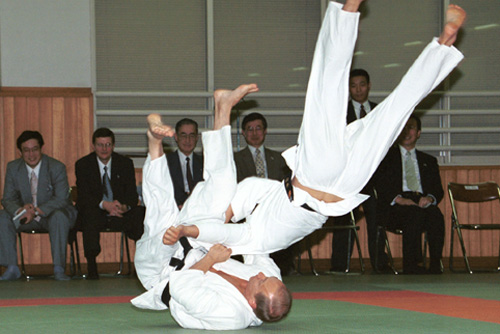
Pondering over who named "Yavara Neva" to the Sankt Petersburg Judo Club, my guess inevitably hit on President Putin, Judoka himself, who is familiar with the Japanese word Yawara (=Yavara) , beautifully adding it to the Mighty River Neva. Yawara is a synonym to Judo.  An ideal Judoka is gentle in appearance but sturdy in spirit – a person of real resilience. During  the '90s the Japanese comics or anime titled Yawara was a super hit depicting a fashionable Judo girl. It was written by Naoki Urasawa, an award-winning cartoonist.

Reportedly Putin began practicing Sambo (a Russian martial art without weapons) first, then switched to Judo at age 14, under his coach and mentor Anatoly Rakhlin. He participated in competitive tours and secured junior national ranking and a senior championship. He kept a blackbelt ranking higher than 4th degree and 9th dan at Taekwondo. When his mentor Anatoly passed away in 2013, he mourned for him as his second father in sports and in life and awarded him a medal of honor. Currently Yavara Sankt Petersburg is managed by Arkady and Boris Rotenburg brothers, both Judoka, who are close to Putin. In 2000, Putin visited Kodokan Judo Institute in Tokyo and met the grandson of the institute founder and legendary Judoka Jigoro Kano (1860-1938).  Kodokan conferred Putin 6th dan grade after testing.

During the Eastern Economic Forum (EEF) held in Vladiostok in 2016, Japanese PM Abe, Mongolian President Khaltmaagiin Battulga and Putin went to see a Judo match, commemorating a centennial Vladiostok Judo club, founded by Vasili Oschepka, the above mentioned Sambo founder. Oschepka trained at Kodokan and was the first Russian dan ranked Judoka under Jigoro Kano.

Sitting together with two presidents, Putin and Battulga, both blackbelt Judokas, PM Abe joked that he would like to see them do a demonstration match. Since Abe does not practice Judo, he would gladly and quietly sit on the side and enjoy the match.  The joke was ignored but PM Abe's reference to the all Japan Judo Federation Vice Chair Yasuhiro Yamashita, who was the 1984 Olympic Judo Gold Medalist and 8 year unbeaten National champion, culminated in an unusual armor-clad warrior match, held in Kodokan, Tokyo in Sept 2017 (see article).

Russian Judo progress has been remarkable, thanks to President Putin's personal pitch and involvement, as evidenced with the recent Olympic medal rush of Gold, Silver and Copper in Sochi and Rio de Janeiro for both men and women. I look forward to seeing how they will perform in the upcoming Tokyo Olympics.