Showing posts with label Toastmasters. Show all posts

Monday, March 14, 2022

March 4

"Ladies/Gentlemen, yesterday (March 4), I completed my 91st year and today started my 92nd calendar year. The best birthday message I received was from a woman friend, a Japanese lady and a great skier from Hokkaido, now living in Yokohama. Was it from Yokohama? Nope! It came from the famous Whistler-Blackcomb Mountains Ski Resorts, the 2010 Vancouver Olympic site, via Facebook Messenger. Never thought she would travel across the Pacific and remember my birthday. Messages were coming in from my children in the US as usual but this skier's message was UNEXPECTED and SPECIAL and made my day. I danced with joy with wavering emotion."

I received another half dozen messages from overseas, a number of Taiwan friends, and Facebook friends.

During the New Year this year, Toshiki Kaifu, the 76th and 77th Prime Minister passed away. He was born in January, 1931, and I thought he was the most successful of our generation. During boyhood, he and I shared the same experiences working as mobilized students at the airplane manufacturing plants. Kaifu was at MHI Nagoya and I at Toray-turned MHI near Hiroshima. I learned that he passed a test to become a boyhood pilot, same as I. I regarded him as a fellow comrade who survived the tumultuous Showa war-time era. Kaifu went to Waseda University, majoring in politics and refining his natural gift of oratory eloquence, but immediately took a job as disciple/secretary of Kensho Kono (1910-1958), a Liberal Democrat politician with free three-meal benefits. Kaifu also helped Mrs. Kono win the election (for one term) upon the death of her husband, which helped him cultivate his own political constituency after this endeavor. Kaifu got elected in 1960 as the youngest Dietman in 1960; then during the scandalous 1980s Recruit's Insiders Trading affairs, he was miraculously chosen as the “cleanest” politician to head the Liberal Democratic Party. Kaifu was 58 years old then.

Now here is my story! What I craved for in my teen years, in reflection, was adventure of other worlds. I was born by the sea – exploring the ocean while growing up! - wherever! - you have to work to live! - then, must learn a foreign language and appreciate different cultures - as well as to increase your sales value - chose (major in) English - first got a hard translation job - studied technology commuting to a two-year college on electricity at night. Was "lucky" enough to go on a first overseas trip in 1957 before the official foreign exchange - then a stable job in NYC in the ‘60s, then on to San Diego, California in ‘70s and ‘80s with family - returned to Japan in 1995. Would have stayed living in California except for an agreement with my spouse - my Californian Dreams shattered and broken.

What have I achieved in California? Work life as compared with my comrade Kaifu? In 1989, I was promoted to Corporate Officer of a US Subsidiary of a Japanese company. That's only two years later than Kaifu becoming the Transportation Minister in Prime Minister Takeshita’s cabinet. Not bad, right? I regularly spoke to over 100 plant employees before they started work.

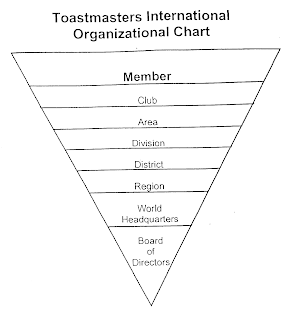
My speech experience helped when I started working on my Toastmaster speeches upon returning to Japan. DTM (Distinguished Toastmaster) Award was consigned to me in 2002, about 5 years after joining the worldwide TM Organization. What I like about TM is that it is a non-profit organization and members are the top tier of the organization, followed by clubs, areas, divisions, districts, regions, headquarters and board of directors (at very bottom) in an inverted organizational chart. You can make as many friends as you like without involving anybody and members are all supportive in achieving excellence, particularly in communication and friendship. TM became my social backbone after retirement. I was reborn and re-established as an ardent TM, traveling all over Japan, Kyushu in particular, in helping TM clubs grow from cradle to being chartered. TM activities became my sense of life fulfillment.
On family life - I am proud my son graduated from University of California, Berkeley with a Master's degree in mechanical engineering and completing the Executive Masters of Business Administration from San Diego State University. He was honored to speak at graduation as valedictorian. My daughter graduated from San Diego State University with a Master's degree in music and she married her classmate who pursued and got his Doctorate. My daughter has given me grandchildren - a granddaughter, now a quality engineer with a chemical engineering degree, and a grandson who is now a freshman at University of California, San Diego. My California Dreams reborn.
Sunday, May 10, 2020

Retiring from Kitakyushu Toastmasters

Dear Kitakyushu Toastmasters,

After much contemplation and brooding amid the social distancing corona pandemonium world, I feel it is time for me to resign from TM. Please know that all Kitakyushu TMs will forever be in my thoughts with great admiration and deep respect.

Reflecting back, we chartered our club on August 8, 1997, the date of double infinity per the late Yasuko Nishimura, one of the cofounders. Elated in spirit, Albert Moe and I declared “let’s establish Toastmasters as a name in Japan”. Yes, we could be a club as prestigious, enjoyable, and comfortable as wearing designer blue jeans. We had four slogans. They were "1 Expand our base, 2 Put our name before the public, 3 Build new clubs from old clubs, 4 Build from youth. Club efforts surely would benefit the community."

All in a family circle, we danced and sang the YMCA song at our jovial 10th Anniversary. In the blink of an eye, the 15th Anniversary came along. We held arms and shoulders together and repeated the YMCA song and dance again. Today, the club had prospered to the level of sending a leading light in District 79, uttered Sumiko Futana, District Governor.

In addition to being a paid member, I had actively promoted activities modeled after TM for about 5 years around the 1980s at my work in California. The mission was to groom corporate personnel to better address employees. One ex-TM member in the Communication Dept. initiated semi-TM classes during off work hours. He assigned 3 speakers, 3 evaluators for the formal speeches, and selected participants randomly for impromptu speeches. We had a contest every three months or so, the winners got trophies (huge compared to those of today) apparently bought from TM HDQ in Orange County. The Club ceased to exist after he resigned from the company. That said, my TM experience easily adds up to well over 20 years.

Personally, I engaged in an around-the-world adventurous TM-trek! Chicago ‘99 was my first Toastmasters International (TMI) Conference. I enjoyed the similar experiences in Anaheim, San Antonio, Atlanta, and Washington DC in the early 2000’s. I attended sister clubs in Canada and Taiwan and then traveled to South America, Australia, New Zealand, Europe, Thailand. The most memorable trip was in 2014 to Kuala Lumpur, the first TMI outside of North America.

I also encountered my share of problems! I was unable to find clubs in Russia, Brazil and China in the early 2000’s. Except for Hong Kong, China had some signs of starting clubs in several major cities but it was difficult to locate them back then. Today, China has thrived with the TM movement.

At a TMI in the US, I sat with a fellow TM. We exchanged cards before exiting. It was Deepak Menom, the current International President. It is a very small world!

I THANK all Kitakyushu TMs. Thank you, Dan Rex, George Yen/Jorrie Wu, Shelly Walkers, Bob Duncan, Sara Mosher, Jiri Pscenicka, George Wagners, Petra Chorador, Lidia Covell and many other TMs, I appreciate your long friendship.

Monday, June 24, 2019

Father's Day Weekend

My old Toastmaster friend Mr. Y called me earlier this month to remind me to attend his speech night on Father's Day weekend. He sounded elated. You'll be treated with the palm dates from my Chad friend, along with my palm date speech, he said.

He had a number of North African friends in connection with his IGES activities. I spiffed myself up with a hair-cut, put on my Father's Day gift – a persimmon colored flower-print shirt which came from my daughter in the U.S. Because I had a couple of errands to run that took a while, I was a bit late in arriving. I found the meeting room full. Usually the attendees number less than 20 with all our members attending. I saw close to 30 people there. Wow! The newspaper membership advertisement worked!

It was a night we call "Speech-a-(Mara)thon." I looked around. Mr. Y was not in. Panicked, I found his speech evaluator sitting close by. I sent her a message asking "Mr. Y"? The answer came back "he is absent tonight because of his sudden illness."

Then I noticed paper plates with palm dates on the table. Oh, my! Those are the dates he had talked about when he called me. I could not resist to beg for my 3-minute talk about the dates at the end of the Speak-marathon to thank him for the palm treats.

This was my speech:

"In place of Mr. Y, the would-be speaker #8 tonight, this is what I know about dates on the paper plates. Dates are called 'Arbor Vitae', fruits of life per the Quran, Prophet Muhammad. The palm grows in Arab countries, in the dry countries and desert under severe weather. The palm date, has served humans for a thousand years or more, and contains not only ample nutrition but minerals necessary for humans, such as iron, calcium, potassium, and phosphorus – a lot more than those found in vegetables. They should be indispensable to a woman's beauty. I know that the dates in the front were from his Chad friend for Father's Day. Let's pray for his early recovery and enjoy and thank him and his Chad friend for the delicious and nutritious treats.

And, for all the father's here tonight - , Happy Father's Day!”

Sunday, October 5, 2014

Kuala Lumpur Fun Night

On behalf of the ToastMasters from Sri Lanka, I am glad that you enjoyed the evening as much as we did. For most of us, it was the first time we enjoyed a fellowship with two international communities. Hopefully next time we can organize an event of a longer duration.

The team from our end that was involved in organizing the event was me, Arshad Mohideen and Trishma Pinto. We would be delighted in getting involved in whatever capacity as Toastmasters united, wherever we are in the world and whatever background we come from.

Please do keep in touch and I hope you will at some time in the future have the opportunity to visit our country, which to us is Paradise.

Warm regards

- Ajit De Soyza


Toastmasters - What expectation did you have when you booked your flight to Kuala Lumpur, Malaysia in August? Myself, as a repeat attendee, I looked forward to the very last event of the Convention, tension running high with excitement and thrills when the winners' calls melt the silence into a roaring applause. The crowning of the 2014 World Championship of Public Speaking!

Secondly, be involved personally in the Board Member election campaign. I wore a Sri Lanka "Balraj" Button the day I arrived. He won and, coincidentally, Sri Lanka became the 2014 world champion.

Third, become friends and hobnob with Toastmasters from around the world. I was to meet a Canadian couple, introduced by my Canadian friend by names only. When I made my registration, I asked the registration staff if there is any way to locate them and, if at all possible, at which hotel they were staying. Their answer was not very promising with such a flood of travelers. The suggestion they made was to use the open message board on the 2nd floor. I posted my message but had doubts how effective it would be. Then I heard each regional conference was scheduled on the last day, and 'bingo', I found a way and we connected.

I wish to report one hell of a fun night I enjoyed, which combined the above 2 and 3 expectations. At the KL hotel where I stayed, I bumped into my fellow DTM Tamura, ex D76-DG, who invited me to join their Fun Night Bout. I joined him without knowing any details, but it was quite an event over and beyond my expectation. If anyone plans similar bouts in the future, this will be a great precedent to follow.

From L to R: Tamura, Floy and Ajit
When Tamura made his business trip late last year to Sri Lanka, he met Balraj Arunasalam who was running for 2nd VP at the KL Conference and he offered to help. What popped up during their conversation was a joint meeting of their respective home TM clubs with details to be worked out between Ajit De Soyza on the Sri Lanka side and Tamura on the Japanese side. Making a long story short, this idea developed into the Aug 22 "Fun Night", unknown unfortunately, to other Toastmasters.

The event was held at a hotel in Bukit Bintang, near Pudu Sentral (formerly Pudraya) where about 60 Toastmasters assembled. Basically there were 25 Japanese (from Kansai area, a dozen women who were clad in Kimono), 25 Sri Lankan and 10 Malaysian Toastmaster volunteers eager to meet, dine and enjoy each others company. Expenses were split: dinners (boxed Bento catered by the KL "Isetan" Japanese Department Store) borne by the Japanese; venue and drinks borne by Sri Lankans and Malaysians.

Dinner started with mingling and chatting. Toastmaster of the Fun Night was personable Trishma Pinto, the right person at the right place. Greetings and speeches were exchanged to cheers and chanting of Balraj.

Soon Tamura led a bell chime rhythm along with taped music and the Japanese Awa Dance theme featuring "Dancers are fools, Watchers are fools, if both are fools alike, why not dance" - started in a circle. Encouraged by this theme, Sri Lankans, Malaysians and even hotel restaurant workers all jumped into the dancing circle and danced for many, many rounds.

Then Sri Lankans and Malaysians answered the Awa Dance with their wonderful Group Chorus, including the local "Baila" song. It was a marvelous "Fun" night to remember for all Toastmasters who participated.

I wish to recognize preparation/coordination efforts of each group as per the following list given by Tamura. Thank you all very much.

Sri Lanka Coordinators:
Ajit De Soyza
Arshad Mohideen
Trishma Pinto
Malaysia Coordinator:
G. Subramaniam
(friend of Kenshi Suzuki, Osaka)
Japanese Coordinators:
Kay & Minoru Tamura
Kenshi Suzuki

Monday, June 16, 2014

60th Anniversary of Fukuoka Toastmasters

Fukuoka Convention you hosted last year won the nation's Toastmasters recognition as the pan-Kyushu’s conning tower, including the bordering prefectures.

I salute you and your dedicated corps of volunteers. You were the salt of the earth throughout the convention. My wife, unfortunately, had her knee meniscus damaged and we were only able to attend on the final day. However, I planned a quixotic challenge of honoring, in vain, Fukuoka Founder Usui, the first Japanese Toastmaster behind the scenes. I'm not going into the inside story tonight. DTM Mohri, who chaired the Convention, knows the details.

TM Usui was the founder but he left Fukuoka shortly for Kitakyushu when he was hired to be on the faculty of Kitakyushu University. He left everything to the 2nd President Tadokoro. It was President Tadokoro who took on the gritty job and faced the full consequences. TM Tadokoro and I both are hearing impaired and as the proverb says "Fellow sufferers pity each other."

TM Tadokoro and I exchanged letters often and he sent me books he wrote. He reminisced about the great honor of being invited to the 80th birthday of Dr. Ralph Smedley in Santa Ana in 1957. He also confided to me that he felt relieved from the heavy burden entrusted on him by Founder Usui. He was happy to have kept his pledge to Founder Usui, a great episode of Fukuoka Founders.

In closing I wish to pay tribute to the Founders quoting TM Tadokoro's essay titled "A Road to Authentic Speaker."

"Strain your eyes in uttering any one word, uttering the first word and the stressed one of a sentence. It is the way you depart from the borrowed language and make it of your own."

May both founders rest easy now, assured that the group they founded will strive to continue the tradition of excellence they established.

Monday, January 13, 2014

Is the Japanese language the Devil's Tongue?

"The popular Weekly Times magazine clearly stated that the Japanese language is the devil's tongue in its special Japanese language edition. Yes, many people may agree because the Japanese language embraces lots of irregular and contradictory rules which are often difficult to comprehend. It seems extremely difficult to master Japanese for people whose mother tongue is different.

Japanese is a compilation of native Japanese, Chinese characters and words of foreign origins. Native Japanese consists of 'Hiragana' and 'Katakana' writing, making it further complicated. Speaking of Chinese characters, there are two ways of pronunciation, one is 'on-Yomi', the other 'kun-Yomi' and very often, there are special 'Yomi' as exceptions to the rules.

On top of all that, the delicate relationship between the persons communicating is reflected in the use of their language, the so-called honorific, humble, and polite words. They are the hardest barriers to break through.

And you might conquer those barriers by being in an environment where you constantly hear Japanese being spoken - listening to the radio, TV, and movies. Your confidence may easily be shattered by encountering local dialects and/or newly imported 'Gairaigo', words of foreign origin. Devil's tongue therefore is not such an exaggeration as Times magazine designates in their article.

Despite my criticism of the Japanese language, I'm the one who had been hooked and captured by the devil's tongue as an eternal student of the Japanese language. Needless to say, language is a tool for communication. Although it is difficult to compare it with other languages, Japanese has a wider and deeper threaded structure and has a lot of atmosphere, which I like most. You may call it gracefulness. It goes deeper into the heart and appeals to emotion, rather than logic and the intellect.

You know how babies learn languages. They unconsciously learn language by listening to their parents and conversations around them. They start talking by repeating sounds. We learn a foreign language in school just the opposite way. We start by reading and writing the new language as we learn grammar. Hearing and speaking are not emphasized as much as it should.

Hence, many people can read foreign languages but cannot speak the language. Our clubs' priority, however, is listening and speaking, so I believe we can create many masters of the Japanese language.

Regarding our fellow Taichung Central Toastmasters, particularly the young and earnest ones, let us pledge our all-out efforts today to listen like innocent infants and speak anything that comes to mind spontaneously like splashing water from a spring, sharing together our joy and pride."

I quoted this awesome and fabulous speech bf Dennis Chen, in full, as above from the Taichung Central Archive "10th Anniversary Keynote Speech." He delivered it in Japanese (Note 1- see original Japanese text) and I just translated it into English for my blog readers who cannot read Japanese. I have never seen such clear and concise introduction of the Japanese language. I saw Dennis's obituary on Facebook hidden among the many 2014 New Years greetings, the most unexpected communication. I'm glad I noticed it. He wrote to me six months ago saying "no more letters please." I was wondering how he was battling his cancer. He sent me a CD a few years ago in which he recorded his own singing of "Like a River Flow," a song popularized by singer Misora Hibari. “Oh, nice, he likes to sing" was my honest reaction without knowing singing was his way of therapy, a desperate escape from the pain of his illness.

I first met Dennis in the late 1990s. It was when I visited Fengyuan Toastmasters, an English language club, with which I was corresponding often and exchanged club newsletters with. The club venue, a Kennex Hotel basement, was full and thriving. Someone must have called Dennis and he came in just about when the meeting was adjourning. Then he took me to Taichung to meet another English club and introduced me to David Wang, who later became Taiwan's District Governor.

I read that Dennis's first encounter with Toastmasters was when he was relocated by his bank managing business from a Fengyuan branch to a southern Taichung branch. One day, at a newly relocated branch, a Canadian professor from the nearby National Chung Hsing University visited to open an account and Dennis was in charge of the customer because he had to address him in English. This Canadian, together with his university faculty members tried to set up a Toastmaster club and Dennis was invited. He was hesitant at first, in fear of the slow progress of study as people get older. But Alice Young, Dennis's wife, recommended that he pursue it and he got on board.

The rest is history as written by Robert Lee, the editor of the Rostrum, the Fengyuan Club Newsletter dated Feb 2000:

"Success doesn't come overnight, especially when we try to start everything from scratch…. However, our Club Founder, Dennis Chen made it happen. Our Godfather, Dennis was a man with a vision. He believed that Fengyuan was a special and unique place where he could uncover many outstanding potential Toastmasters without any problem… Believe it or not, he was also a member of Taichung, Wheelers, Beast and Fengyuan at that time."

Dennis was listed among the Hall of Fame - 1999 ROC Japanese Toastmasters’ Tall Tale Contest Champion.

We Japanese Toastmasters have lost our best friend from Taiwan and the best Japanese speaker there.

Note 1:
Dennis Chen and his wife Alice Young joined the International Toastmaster on April 4th 1984. Since then Dennis established seven clubs, including clubs for four different languages. Dennis really set a good example for every Toastmaster member. Dennis used to say "Old soldiers never die."

Note 2:
2007セントラル会創立10周年
発起人の挨拶

「悪魔の言葉」に挑戦

世界で一番有名なアメリカの週刊誌タイムに掲載された日本語特集の記事に、 日本語は「悪魔の言葉だ」と、はっきりと書かれていました。確かに、日本語には、不規則で理解しにくく、ルールが矛盾しているのでは、と思われる部分が沢山有ります。日本語が母国語でない人々がそれをマスターするのは、極めて難しい事の様に思えます。

日本語は、和語、漢語と外来語の混合体ですが、先ず、和語は平仮名と片仮名で表現されるので、複雑になります。次に、漢語には、音読み、訓読みと言われる2種類の読み方がある上に、別の特別な読み方がある場合も決して珍しくありません。更に、話し手と聞き手の間の微妙な関係で使い方が異なる尊敬語、謙譲語と丁寧語は、日本語を習得したい人達の前に立ちはだかる最も高い壁だと思います。こういった難しさを克服して、日本語をある程度勉強しても、ラジオ、テレビや映画の随所に出てくる地方の方言や新しい外来語を耳にすると、たちまち自信が無くなってしまいます。ですから、悪魔の言葉といわれるのも無理はないと思います。

以上、散々日本語の悪口を書きましたが、実は私が日本語演説会の会員達と同じく「悪魔の言葉」魅せられて、永遠の日本語学習者になってしまったのです。もともと、言葉というものは、コミュニケーションの道具です。他の言葉と客観的な比較は出来ませんが、日本語は幅が広く奥ゆかしく、論理的というより、むしろ情緒的な言葉ですので、頭脳というよりは、心の奥深くに届く点が、素晴らしいと思います。

言葉を学習する一番よい方法は、赤ちゃんが言葉を覚える遣り方だと思います。 赤ちゃんは無意識に父母や大人たちの話を聞いて、時間が経つにつれて片言で話 をし始めます。しかし、私たち外国人が学校や塾で外国語を学習する時は、順序が違います。

ほとんどの場合、教科書から読み始め、字を書き、文法を習います。聞くことと話すことはあまり重視されていませんので、難しい外国文学を読める人が外人との簡単な会話を流暢に話せない様な事が良く起こります。その点、日本語演説会では「聞く」と「話す」に重点を置いているので、「日本語の達人」が生まれてきます。私達の欠点を十分に直すにはよく聞き、よく話すことです。子供のように、無心で聞き、

思いついたままに話すことができたら、しめたものです。私達の台中中央セントラル日本語会は創立10周年になり、今月から第11年になります。例会、読書会、親睦会やコンテスト等の活動で会員達に日本語を充分に話せる環境を提供して来ました。

会員達(特に熱心な若い人)は著しい進歩。これからも、このクラブの素晴らしさと楽しさを皆さんと分かち合ってゆきたいと思っています。皆様、誇りを持って、頑張りましょう。

Saturday, February 23, 2013

I So Love Shimonoseki!

Speech given on Feb 20, 2013 at Tokyu Hotel cafe lounge
"Live a pleasant life in the unpleasant world!" This is a famous quote of Shinsaku Takasugi, Choshu Clan Samurai, perhaps your hero, who played a pivotal role in the pre-Meiji Restoration. He passed away young before his dream came true; however, his strategy of organizing militia and his visionary leadership should well be long remembered.

Ladies and gentlemen and guests, I'm honored to speak today for Shimonoseki Toastmasters in the making. Shimonoseki is my favorite city where I'm always hoping to return. My sister-in-law invited my wife and me to live in Kitakyushu upon our return to Japan from the U.S. The first place she drove us to was Tsunoshima Resort, a beautiful cobalt blue ocean view and sand beach and a bridge to the island. The scenery is comparable to the 7-mile Bridge, Key Largo, Florida. I was so impressed that I have taken American guests there, also my son from New York and my granddaughter from California.

Representing Kitakyushu Toastmasters, I was fortunate to meet today's Chair TM Miyake. She visited with me at Kozanji, Mohri Palatial Residence, Nogi-jinja, etc. in Chofu. I had a chance later to visit Akama Shrine, Shunpanro, Yume-Tower, and Karato. Oh, I so love Shimonoseki!

Thank you for coming today to join us in our noble venture, and I know you are anxious to know what Toastmasters is all about. First and foremost, Toastmasters is a non-profit organization that operates clubs worldwide for the purpose of improving English communication and leadership. Founded by Dr. Ralph Smedley in California, it covers over 110 countries and accommodates a quarter million members. The greater San Diego District, where I used to work, had a population of 3 million and had about 150 clubs when I left. In other words, 50 clubs per million there. Upon my return in 1995, I found clubs in Japan narrowly reached 60.

Kyushu had only one club, in Fukuoka, right after the war, started by a GARIOA scholarship student who came back from the U.S. It is one of the oldest clubs in Japan. Fukuoka, therefore, had a few Kitakyushu members who commuted twice a month by train. They were so happy to join the newly formed club in Kitakyushu. It was in 1997, over 15 years ago. Now the time has come for Shimonoseki to claim the same exciting beginning.

New members will learn tonight, through well established protocols - the one minute self-introduction and the two-to-three-minute response to table topics question. Then, after you are inducted as a member, you must give a formal 6-minute speech. You will then be evaluated by your friendly fellow members and the mentor in charge for improvement. Friends help friends practice in a warm accepting atmosphere. You will advance step by step following the Toastmasters Manual, the treasures of this century old wisdom to success. The project manual covers speech organization, vocal variety, language, gestures, humor, persuasion, etc.

I'm sure each of you has made your New Year's resolution in January to brush up and expand your English communication this year. It's never too late to empower yourself by way of joining the Shimonoseki Toastmasters as founding members. Seize this opportunity and realize your dream! It is better late than never. Welcome to an exciting adventure.

Saturday, December 10, 2011

The Xie-Xie Taiwan Project

I traveled to Taiwan in mid November to attend the D67 Fall Convention in Taichung. It was my 10th visit to Taiwan. I had a special mission of my own. To thank the Taiwanese for showing their compassion towards the Japanese plights on and after 311.

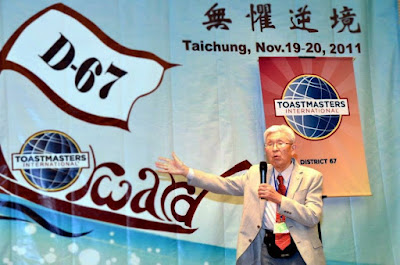
Convention programming is usually a hectic one, allowing no interruptions and changes. Foreign visitors are usually recognized by the District Governor and I dared to grab the opportunity, with the prior consent and approval of DG Grace Shih, through Dennis Chen, an old friend and the founder of Taichung Central Japanese club. My speech went like this:

Hello, Taiwan Toastmasters! I wanted to come and thank you personally for the very much needed help from the Taiwanese who pitched in right after the 311 Earthquake/Tsunami that hit Tohoku Japan. Thank you, Taiwan.

I didn't attend the Spring Conference but got your jia-yu (加 油)messages posted on the wall during the Spring Conference that was carried back by our delegates to convey to the rest of Japan.

Taiwan topped all quake donors through the Red Cross along with your rescue teams and relief goods that were dispatched.

So in order to physically express gratitude, the Japanese swimmers did a 110 kilometer open water swim in relay from Yonaguni Island of Okinawa to Su-Ao Taiwan, despite the approaching typhoon, calling it the Xie-Xie Taiwan Project. I'm a swimmer myself. I would have joined them if I was younger.

Please accept our Xie-Xie Taiwan voices from District 76. All of the Japanese Toastmasters are very appreciative and deeply touched by your warm feelings for the Japanese.


After the session and during the break, some Taiwan Toastmasters came to shake hands with me. I was happy that I got my message through.

Friday, April 8, 2011

Earthquake / Tsunami Update on a Fellow Toastmaster

One love, one heart
Let's get together and feel all right
Hear the children crying (One love)
Hear the children crying (One heart)
Sayin', "Give thanks and praise to the Lord and I will feel all right."
Sayin', "Let's get together and feel all right."
Whoa, whoa, whoa, whoa


- Bob Marley (1945-1981)
named song of the millennium by BBC

UPDATE - GOOD NEWS!

Safety of all Kesennuma Toastmaster members confirmed as of April 8. They had two members who had been out of contact after March 11. One member resides in Tome City, bordering between Miyagi and Iwate prefectures. Tome is about 30 to 40 kilometers from the coastline. The other member resides in Rikuzen Takada, in Iwate Prefecture. Rikuzen Takada faces the ocean but his house was not inundated by tsunami as it stands at higher ground. This news is from the Web site Kagurazaka Toastmasters in Koenji started under the yellow banner initiative. It carried a photo of four spirited Kesennuma Toastmasters.


***

A special impromptu writing corner at the recent Taiwan Toastmasters Convention (April 22-24) in Taipei to encourage fellow Japanese Toastmasters. 加油 pronounced "jiayour" means "Fight". Each pasted a pad of note of encouragement with his or her signature.

***

I sent the following message to my overseas friends, Toastmasters and personal alike about a week after March 11, to which responses returned in drove. I thought I should share these responses with more people rather than keeping it to myself, so I’ve decided to post summaries as a blog extra. Thank you for all the messages you sent me with your prayers.

When I found the name Kesennuma among the cities hard hit by the Tohoku Earthquake, I immediately thought of Daniel Ross, founder of Kesennuma Toastmasters. I met him years ago in one of the District Conferences featuring speech contests in Tokyo. His name card read "Owner of Pine Rock School". Perhaps it was before the Kesennuma club was founded. He was quite a likable man. I only knew Kesennuma by name as a famous fishing port of saury and the bygone gold mines. So I asked him how he liked it there. He told me the city is small (pop. 73k), but he likes it because it has retained a natural beauty and small town charm with all the amenities that a bigger city has to offer.

I was happy to hear he was “OK” from a fellow Toastmaster. But that was the only status given on the people finder website.

Today, I got the latest message from the same source and felt really relieved to see it was written by him.

Indirectly reported was his message to his mother in Florida. He said he and his wife were safe. Their house survived the earthquake and tsunami because it stood on higher ground. Among the relatives an elderly aunt of his wife was still missing. On March 11, the port and business of Kesennuma were completely wiped out by humongous tremors and tsunami that followed. The huge oil and fuel tanks for steamers exploded and burned oil at night at the seaport. There was no power, no phones, no Internet, and no water whatsoever. Even cell phone signals were completely out or usage blocked so emergency services can use them exclusively. 15,000 dead in Miyagi. Many others are still missing. Innumerable now in evacuee shelters.


Here are the replies I got back:


Thank you Rio. Believe me, the people of the world have their hearts vibrating in emotion for the people of Japan. It will be a long time, but the Japanese people will put their world back together. I often wonder how many Japanese people are somehow thankful that this calamity did not come upon them by the hand of other human beings. I think about that every day when I join you in spirit.

- Paul (CA, USA)


I was out of the country during the terrible earthquake and tsunami; I hope you are all safe and well. Is there anything I can do to help? You are all in my thoughts and prayers.

- Paula (IN, USA)


Thank you Rio for sharing. So sad what has happened to Japan. The people of Japan are a model to the rest of the world in their behavior and tenacity. Stay well,

- Mikkie (FL, USA)


Aloha, Rio,
During the War time I was evacuated with my elementary school to Tanakura, Fukushima-Ken. The village is too far inland to be affected by a tsunami but may have sustained damages from the earthquake. Since my departure from Japan in 1955, I have not ventured to Tanakura, but did visit Koriyama with a tour group from Atsugi Naval Air Facility.


- Young (HI, USA)


It goes without saying that my sympathies are with the families suffering from the tsunami and earthquake and nuclear disaster that followed. The only ray of sunshine on the whole matter is that the people of Japan are resilient and do have the will and the means to eventually recover from it. Of course the loss of lives is not a recoverable feature of the will of the people, and the tragedy continues to go on as more bodies are recovered and more missing never found again. My heart goes out to those who were.

- Fred (CA, USA)


I am glad that you were not directly and physically affected by the tsunami or the quake. My heart goes out to those who were.


- Fred (San Diego, CA)


We have just returned from a six week trip and I do not think I wrote to you, though my thoughts were with you during the horrific news coming from Japan. I am relieved to hear that you and your family are safe. We were in Bali when the disaster struck and as you may know there was a small earthquake there the same night. We were flying to Australia as the news of the Tsunami broke...and we missed the initial coverage of what was going on. Of course our family was worried sick since there were at the same time tsunami warnings for Bali and Australia...none materialized, thankfully. But we didn't even know about the threat...also thankfully. We continue to pray for the safety and recovery of those who survived the disaster. Sending you good wishes for your family and countrymen.

- Joanne (NY, USA)


Thanks for the update Rio. It must be terrible to be in the middle of this tragedy.


- Allan and Angela (Canada)


Myself, friends and family here in Canada are concerned about my friends in Japan and the devastation your country has experienced. Sending you and everyone in Japan healing thoughts.


- Cristy (Canada)


Thanks so much for all your emails. It's great to know that you are doing ok. It's disheartening to see the images of Japan on the news and I could imagine how the local residents feel having to cope with the recent events. I have been thinking about the friends I met at Takarazuka Club. Have you heard from them by any chance? I sincerely wish them well.


- Reamick (Canada)


Glad to learn this morning that the nuclear crisis is finally wrapping up. Best to Japan!


- Lucien (Canada)


Yes the earthquake in Japan was/is terrible. We thought all the calamities in Australia were bad enough but they were absolutely nothing compared with the devastation in Japan. All those poor people missing and now the Nuclear catastrophe.


- Jose (Australia)


Glad to hear Daniel Ross is okay. The figures of the dead and missing are tremendous, so a small city may be completely wiped out, but not Kesennuma. I vaguely remember that around January 1, 2011, there were predictions made by various people who have predicted correctly in the past. As I recall I think some of the prediction were that the year 2011 would be a "hard" year both in natural disasters and in man-made (Middle East countries) disasters. It seems to me that those predictions have come true. So if there are other planets that are populated in our galaxy and other galaxies, then I hope we can find them and see what their secret to peace may be. The young man that was teaching in one of the international schools and who I thought was in the Tokyo area has shown up at his mother's apartment in Brunei, so at least Imran is safe.


- Shirley (Australia)


I still remember your speech about volcanoes at the Morris Gellman club in Buenos Aires and your several trials to climb Mt. Fuji. In some way or other you were then predicting these circumstances. I have my doubts if anyone could imagine what you are experiencing these days. It is nice we can hear from you once more. Our best regards from all Toastmasters members in Buenos Aires. I personally accompany you with my prayers.


- Lidia, U-4151 Morris Guellman Toastmasters Club (Argentine)


It is a terrible tragedy that afflicted Japan. Hope you and your family are safe. Do you have any relatives in northern parts of Japan? Our thoughts are with you. Let me know how you are, please.


- Jiri (Czech)


I hope that Japan will recover soon from the disaster. The kindness of Japanese in helping the victims of disaster gained high acclaim. There was no riot, no robbery during the disaster in Japan. The good discipline of Japanese has shown that Japan is a VERY successful country!!!


- Josephine (Malaysia)


Hello, Rio-san!
Stand firm. We pray for Japan.


- Natasha (Russia)

Thursday, April 30, 2009

Translated version of Dear Miss Breed now registered at the National (Japan) Diet Library

A good friend is a great blessing. Our friendship, based on Toastmastering and deepened with travel, led to the book Dear Miss Breed that I translated to become registered with the Japanese National Diet Library.

In early 2000, our Toastmasters Club in Kitakyushu invited Professor Kobayashi from Shimonoseki City University to a meeting. An excellent speaker, in an ice breaker speech, Kobayashi Sensei talked about his young days in Hawaii. We learned that he graduated from the University of Hawaii with a master's degree and later earned a PhD. In 2004, he gave his retirement lecture "50 years as an Asian researcher" to Shimonoseki citizen and his students, and returned to Yokohama to live with his family. In the fall of 2006, the Kitakyushu Club invited Kobayashi Sensei to join them in attending the Toastmasters Convention held in Taiwan. He gladly accepted it, and so, three of us, Oshiumi, Kobayashi and I flew down to Kaoshiung representing Kitakyushu. There he volunteered as an ad-hoc speech demonstrator during the training sessions and was immediately surrounded by young Taiwanese fans throughout the convention. He happened to be fluent in Chinese and was a big help when we traveled to Taipei via Tainan, Chiayi, Poan, etc. and visited Taiwanese industries and universities on the way back.
A photo from Taiwan Toastmasters Conference. I am addressing the audience (of about 1,000 people) as a representative of Kitkayushu as well as District 76 (Japan) Toastmasters. Behind me were Masaki Oshiumi and Eiji Kobayashi.

One of the books he wrote in 1979, Developments of Indus River, Agriculture and Water Problems in India/Pakistan, was highly acclaimed by Japanese financiers and industrialists, Asian scholars as the best introduction available of the area. He gave detailed history of how India and Pakistan disputed water distribution and how the Tarbela Dam, the world's largest embankment dam, helped solve the problems from the Asian Development banker perspective. He was a banker himself then, before he became an educator.

I forgot that I sent the publication notice of my translation to the professor. After a month long trip to California, I found his letter, dated March, waiting for me upon my return in April.

He wrote that he was so impressed with the translation of the book that he felt the need to help promote the book. He voluntarily sent his book review to the biannual newsletter published by and for the ex-employee association of the National Diet Library. Attached to the letter he sent me was the said Newsletter No. 44 dated March l, 2009 with a full page of the book review.

My quick search yielded the following designation of my book at the National Diet Library as follows:

NDC (Nippon Decimal Classification) - (9) 334.453,
NDLSH (National Diet Library Subject Heading) - JP: 21460307

Thank you, Kobayashi Sensei. I feel really honored. I'm hoping that I may travel again, not only to Taiwan, but to other Asian countries where your expertise shines.

*****

Book Review by Dr. Eiji Kobayashi (formerly with the Legislative Reference Bureau, National Diet Library)

As in the subtitle, the book depicts "the true and heart warming stories of Japanese American children and a librarian Clara Breed" in San Diego, California. During World War II,.Clara taught the children of the neighborhood how to enjoy reading and was popular as their friend.

It all started the day of December 8, 1941, when the Imperial Japanese forces raided Pearl Harbor. I myself remember the day well as a first grader. However, until I read the book, I didn't know what happened to the Japanese Americans in the West Coast, as a consequence of the raid. In reflection of the Americans' terrible fear of a possible Japanese invasion of California, then President Roosevelt issued his Executive Order to evacuate all those people who had Japanese ancestry, regardless of their status of naturalization.

Suddenly on April 8, 1942, a total of 120,000 Japanese Americans were interned into relocation camps scattered internally off the coast lines. The children Clara Breed served as her students were first sent to the Los Angeles Assembly Center. There they had to live in horse stalls turned housing, which emitted a most unpleasant odor.

It was shocking to Clara Breed who believed incarceration based on being a descendant of a particular nation was a mistake. She began to receive letters from her children, all with the heading "Dear Miss Breed." Children wrote about their camp lives - barbed wire surroundings, watchtower guns aimed at those inside rather than intruders from outside, waiting in long lines for everything from meals, laundry, showers, mail, etc. One young man (Tetsu), desperate from seeing nothing but shanties wrote that he was betrayed by his mother country. They were then herded into a permanent detention camp in Poston, Arizona, in a desert full of snakes, scorpions, tumble weeds. There they had to face extreme summer heat, sand storms, freezing air and bitter coldness in winter. Riots broke out among those who could not bear their situation.

Clara Breed continued to ship books to children in the camps for encouragement. She sent not only books but also some daily necessities, shoes, woolen yarns, socks as requested by children in their letters along with candy and gum. Christmas presents Clara sent particularly cheered up the children. In their homesickness they asked Clara to update them on news from San Diego. Soon some of them graduated from high school and joined the American military or entered universities, leaving their camps with WRA permissions. San Diego, a naval town, however, was reportedly still hostile toward them and children hesitated to return there despite their homesickness.

In 1970, Miss Clara Breed, then promoted to the Head Librarian, had a great reunion with all the children who finally returned to San Diego. She retired from the the San Diego Library system after 42 years of service and passed away in 1994 at the age of 88. Her creed was "I can't imagine life without books. Reading is food for the spirit and immeasurable."

Author Joanne Oppenheim (born 1934) has written many children books. She happened to see the "Dear Miss Breed" letters in the National Japanese American Museum and contacted the writers of those letters to interview them in hopes of putting faces to Breed's human characters and to document the period of infamy in American history.

I know the translator, Rio Imamura, who worked for a San Diego manufacturer and was a resident there for over 20 years. We are fortunate to be able to read Oppenheim's book in Japanese published by Kashiwa Shobo. Thanks to his hard work, explanations of photos, illustrations, footnotes and indexes are all painstakingly translated for easy reference. I was glad to see that all the library terminology was correctly translated.

America saw the birth of the first African American President, Barak Obama, who proclaimed "Change". However, has America really changed as in President Obama's slogan? Am I the only one who feels that the dark shadow of racial discrimination and injustice still continues to linger in America and elsewhere?

(Review translated by Rio Imamura)

Original Text: