Showing posts with label Kazuo Inamori. Show all posts

Monday, September 22, 2014

The Vietnam War Remembered

Rest well, my child of the yellow race
I'll rock you gently
and heal your gun wounds
You went to war at the age of 20 years
Never returning home
Sleep, my child, sharing my yellow skin
I'll lull you and coax you
I'll do it twice
This body
which used to be so small
that I carried in my womb
that I held in my arms
Why do you rest at the age of 20 years?

"Lullaby" (Ngu Di Con) by Vietnamese Lyricist and Composer Trinh Cong Son (1939 - 2001), about a mother grieving her son who has gone off to war, became a hit in Japan in 1972. When he died at the age 62, he was dubbed the Bob Dylan of Vietnam by American singer Joan Baez. He gained fame in the 1960s for his love ballads and anti-war anthems, and has just been posthumously awarded a 2004 World Peace Music Award (WPMA), alongside other well-known names such as Harry Belafonte, Country Joe McDonald, Peter, Paul & Mary and well, Baez and Dylan.


Da Nang in Central Vietnam was my next stop after visiting Hochimin. The distance between Hochimin and Da Nang is about 1000 km. I found Da Nang Airport as unboundedly open and shining, contrary to my preconceptions from the stained image of the Vietnam War. Yes, a modern city with good roads and bridges. I was met by a taxi driver sent from my Hoi An hotel at the airport exit and sped south after clearing city traffic along the beach with luxury hotels and condos and golf courses. The scene looked familiar. This is Southern California!
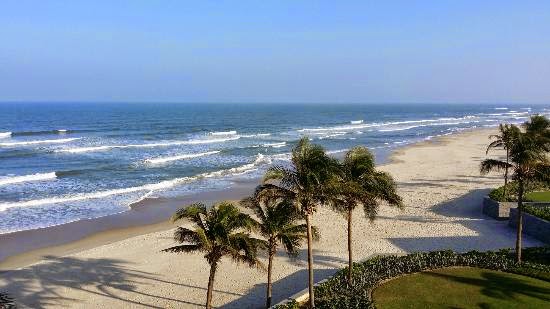
I've read that the US Marine Corps Battalion Landing Team, wearing full battle gear and carrying M-14s, met Vietnamese girls with leis, South Vietnamese officers, sightseers, carrying a large sign "Welcome, Gallant Marines", and General Westmoreland was appalled. I was similarly baffled with the "Southern Cal scene” in Da Nang, Vietnam.

I am glad that I dropped Hue, the old capital, from my itinerary. Heading north, you have to dash up Hai Van Pass and necessarily touch upon the 1968 Tet Offensive related Hue massacre. Hue is where Trinh Cong Son, the "Lullaby" composer, lived.

Reachable from Hue are many historical US versus NVA battlefields (Khe Sanh, Con Tien, etc) on the 17th Parallel DMZ where the US had tried to block NVA infiltration into the South through Ho Chimi Min Trails, as well as the Vin Moc Tunnel Complex, which was dug deeper than the US bombs could penetrate. More than 400 villagers survived the war and more than 40 new babies were born underground. However, they could have been victims of Agent Orange, the defoliants.

I was stationed, as a Japanese businessman, in the U.S. during the Vietnam War and saw nationwide upheaval, anti-draft hippies and anti-war student marches.

I remember David Halberstam, in Saigon, as a New York Times correspondent. He was among a small group of American reporters who began to question the official optimism about the growing war in Vietnam. The Communist government in the north enjoyed wide spread support in rural Vietnam. The US-backed Saigon Government was quite unpopular. Halberstam saw Vietnam as a moralistic tragedy, with America's pride bringing about the government’s downfall. Although he won a 1964 Pulitzer Prize for reporting, he was transferred to another bureau.

I safely chauffeured David Halberstam to Kearny Mesa when he flew into San Diego Airport. He visited my former employer's plant to interview the company’s founder Kazuo Inamori, who happened to be visiting San Diego at the time. Halberstam was preparing for his 12th book "The Next Century" and found Inamori's nickname Mr. AM quite intriguing.

Halberstam taught that the moment humans lose their modesty, it inevitably leads to hubris and arrogance resulting in the demise of everything. Kazuo Inamori, who later read "The Next Century", warned his employees to "avoid paved ashphalt roads” and not “be afraid to take dirt roads."

I wrote that I drove Halberstam "safely." In 2007, David Halberstam was killed in an unfortunate traffic accident in Menlo Park in a car driven by a Berkeley student.

Jack Langguth (unusual surname so I remember it well) succeeded David Halberstam at the Saigon NY Times Bureau. Jack was sympathetic to David. When I did a search on him, I was surprised to see his obituary a few days ago. It was Sept l, the day I came home from my Vietnam trip. He was 81. We are of the same generation. After retiring from the New York Times, Jack taught journalism at USC in Los Angeles. He not only wrote books about Vietnam, but history and children books as well.

I wish to dedicate this blog entry to all those who perished during the Vietnam War and to David Halberstam, Jack Langguth, and Vietnam pacifist composer Trinh Cong Son.

Monday, June 22, 2009

Strategy of Enthusiasm Produced a Winner!

While searching the Internet looking for a friend of mine in the State of Washington, I came upon a site that led me to a businessman I had once worked with on a project about 20 years ago. I could not quite recall his name. He was once the Mayor of Vancouver, a high profile public servant. I figured there must be a clue as to what happened to him, so I googled "Vancouver, Washington".

A familiar Columbian newspaper article dated 2005 appeared titled, "Vancouver has found its heart and maybe its soul. They reside in the spirit that reinvigorated Esther Short Park." It was written by Tom Koenninger, editor emeritus. He wrote:

"Roots of Vancouver's coming of age may have started with former Vancouver Mayor Bryce Seidl and the Nihonga exhibit on Officers Row, and the survival of Officers Row itself in the mid-1980s. The goal was to re-energize the heart of the city, Esther Short Park and environs. Thanks to guts, energy, brains and no small amount of sweat, the objective has largely been met. What a change."

Yes, that's it! Bryce Seidl! I recognized his name. I remember that I liked him.

It was fairly easy to proceed once I knew his name. I found out that he is currently President and Chief Executive Director of the Pacific Science Center, a nonprofit organization in Seattle. This is the man I met and worked together with, on introducing the Nihonga (Japanese painting) exhibits in the City of Vancouver, Washington.

Why a Nihonga art exhibit in a small city like Vancouver, Washington? Kyocera International, my ex-employer, built a company called Kyocera Northwest there. Mayor Seidl was invited to the opening ceremony. He met then Kyocera President Kazuo Inamori and learned that Kyocera and Wacoal, another Kyoto based company, were jointly planning to bring a tour of traveling Nihonga exhibits to Paris, London, New York, Los Angeles and other major cities.

Bryce was interested in the project and asked Inamori to include Vancouver among the exhibit host cities. How well could Vancouver, such a small city, rank against those large capital cities in drawing visitors to the exhibits? Nobody listened seriously to the mayor, but Seidl had his ideas and a vision. He believed he could do it. He sent his plan to Kazuo Inamori, even advising him on the critical paths to take in order to make the project a success. Kazuo Inamori himself likes to do this type of thorough market research and simulation-proven studies, and he was moved by spunky Seidl. Gradually, Bryce's enthusiasm and persuasion took shape and weight, and moved the Kyoto people. Seidl's planning was superb - the selection of the venue at the historic Officers Row, the well-timed visit of a Japanese sailboat at the Columbia River basin, the invitation of several Nihonga artists to speak at the opening, even preparing souvenir pamphlets and prints, etc.

To our surprise, Seidl's plan culminated in attracting more visitors than any other capital city mentioned above. And can you guess why?

Bryce mobilized students in all the schools in the neighboring counties. I was dispatched for a few weeks from the Kyocera U.S. Head Office in San Diego to help in the preparation, and I saw Bryce rolling up his sleeves, working as hard as those involved at City Hall. I was very impressed. The event took place in 1986.

I saw a recent photo of Bryce Seidl on a Web site. His hair and eyebrows are turning white, same as mine. Maybe he is a bit younger than me. I found out he majored in ecology at UC Berkeley, and received an MBA from the University of Michigan. Between two careers, first as city mayor and currently as Executive Director at the Pacific Science Center, he has held many positions in the Seattle area: VP/General Manager at Simpson Papers, President of Fisher Mills, and President of Pilchuck Glass School, a glass art school that has much in common with Nihonga art.

I'm hoping to visit Seattle on my next trip to the U.S. and renew my acquaintance with the ex-mayor I admired.

***

Notes:

Nihonga Exhibit
Kyocera jointly hosted the Exhibition of Modern Japanese Nihon-ga paintings with Wacoal Corporation in 1985 to promote international friendship and cultural appreciation by introducing Japanese paintings overseas and creating an international venue for exchanging art and culture. The exhibition was held in seven cities in five North American and European countries over two years and earned widespread acclaim.

Officers Row in Vancouver, WA
My friend Christine Kuramoto, an English teacher at Kyushu University, who was born in Vancouver, WA, sent me the following email:

"Hailing from Battle Ground Washington, a small city a few miles North of Vancouver, I grew up thinking that 'our' Vancouver was 'the' Vancouver. Of course later, when my travels took me farther from my roots in Southwest Washington, I learned that 'my' Vancouver was actually the 'other' Vancouver. The Vancouver that everyone else knew about was that one up North in Canada, or Vancouver BC. I often had to go through a long explanation of how there is also a Vancouver in Washington State just across the mighty Columbia river from the City of Portland, Oregon.


My City's name, Battle Ground, comes from a battle that never took place. In 1855, some Klickitat Indians escaped from Fort Vancouver. Captain Strong headed up the army in charge of bringing the Indians back to the fort. Upon meeting up with the Indians, the Indian chief, Chief Umtuch, promised Captain Strong that the Indians would return to the fort. There are different versions of what happened next, but somehow Chief Umtuch was killed. Captain Strong allowed the Indians to bury the chief. He returned to the fort with the Indians' promise to return. The Indians did return, and for not forcibly bringing them back, Captain Strong was presented a petticoat for bravery and courage. This area later became known as "Strong's Battle Ground". I went to elementary school at Chief Umtuch elementary and there is now another school called Captain Strong elementary school.

To me, Fort Vancouver and Officers Row was the place you went and spread your blanket early on the 4th of July if you wanted to get the best view of the fireworks display on the independence day holiday. As a child I never really noticed or realized the significance of the beautiful historical houses there along the row. But as a middle-aged woman, I now have more of an eye for the beauty that is there. If you are ever in the area, I highly recommend that you take a stroll down Officer's Row in Vancouver. And if you have the time, take a little detour North and see my hometown, the city where a battle didn't take place near the 'other' Vancouver, Vancouver USA."

*Marshall House Photos Courtesy of Mrs. Nagano*