Sunday, January 27, 2019

A History of Sweets

Have a sweet tooth?  Listen up!

My speech I gave at Toastmaster's recently was about the history of sweets, favorite things to many, I'm sure. Relax in your chair and enjoy.  Maybe even close your eyes.

Before Christopher Columbus, the world didn't know anything about chocolates - such a delicious treat didn't exist.  It was Hernandez Cortez, the Spanish Conquistador, who introduced it, borrowing the name from the language of the Aztecs, Nahuatl, "xocolatl".  This word is built on xococ "bitter", a drink made by a sugar free people from Cacao, itself from Naguato cacauatl "cacao".  Similar Aztec words are avocado, coyote (wild animal, smuggler), tecolate, chipotle. Chipotle is the top California Mexican grill.

Now let us review the Mayan myth a little bit. God was creating the world to be fair and well-balanced:

Give country A a vast land but, be harsh in climate.

Country B is small - let's compensate it with delicacies from land and sea.

Now comes Mexico. Fairly good sized but mostly desert and hot. God said OK, leave it as is....  God heard a shadow voice. "It's a pity to leave it as is. Can you add something?"  So God sent Quetzalcoatl to check it out. He brought many goodies to Mexicans: corn, cotton, and cacao in particular, my subject tonight.  But this benefactor god, disguised as a feathered serpent, vanished suddenly.

Cortez, Spaniard I mentioned above, landed in 1519, the year Quetzalcoatl was believed to return. Cortez faced no resistance. Instead, Cortez was welcomed by Montezuma, a Mayan Emperor. Montezuma served Cortez in golden goblets, a "Theobroma" ritual.  In Greek, theobroma means food from God.  Cortez found it bitter, and did not find it to his taste. However, Montezuma reportedly drank 50 chocoatl a day. To make the concoction more agreeable, Cortez and his countrymen added vanilla and other miscellaneous ingredients.

The Spaniards took chocolatl to Europe.  It gave a sudden rise to all kinds of confectioneries and world enterprises. After many centuries, companies like Hershey, Godiva, Nestle, See's, Mars, Kinder, and Dove survived, just to mention a few. I'm sure you know them well.

Many thank Cortez for adding tasty pleasures, tickling our taste buds and giving us moments of sweetness. Today’s talk was just a tasty slice of history.

Monday, January 21, 2019

Beethoven’s Ninth Symphony

Freude, schöner Götterfunken,
Tochter aus Elysium,
Wir betreten feuertrunken,
Himmlische, dein Heiligtum!
Deine Zauber binden wieder
Was die Mode streng geteilt*;
Alle Menschen werden Brüder*
Wo dein sanfter Flügel weilt.

(Joy, oh what a godly sparking, daughter of Elysium, drunk with fire we're embarking, blissful, in your holy room Your spell's magic mends each other's ties our customs strictly breach, all the people will be brothers where your gentle wing shall reach)

One miracle in postwar Japan has been that people say the year isn’t over without listening to a chorus singing the 4th movement of Symphony No. 9 (affectionately called “Dai-Ku” in Japanese) composed by Master Ludwig Van Beethoven. Major cities as well as the local cities, Hokkaido to Kagoshima embrace Philharmonic Orchestras’ performing this choral symphony at the close of each year, some even being performed on New Year's Eve. Let’s explore the background story, tracing some historical twists from both World War I (WWI) and World War II (WWII).

Why and how this tradition came to be, comparing, for instance, to Germany where very limited yearly performances are reported. For one thing, Japan was the first country in Asia where the chorus echoed triumphantly by Germans who performed the piece under unusual circumstances. It was the year 1918 (just one hundred years ago). German POWs from WWI were detained in Bando City camp, Tokushima in Shikoku (see 12/28/2010 post for details). I visited Bando Concentration Campsite, Tokushima in 2010. The memorial German House opened in 1972 with exhibits of utensils German POWs used to bake bread, make ham and sausages, etc. What was fascinating was a diorama and a robotic theater illustrating the Germans playing Beethoven’s “Dai-Ku” symphony, with instruments in their hands and a chorus group (men only). Dai-Ku performance was recorded in Tokyo under the Japanese conductors since 1920s. In 1927, the former NHK orchestra played under Joseph Koenig. Conductor Hidemaro Konoe directed Dai-Ku 10 times between 1928 and 1935. Joseph Rosenstock conducted the former NHK orchestra in 1938, the year celebrating 100 years after Beethoven’s death.

At the end of 1947, “Dai-Ku” was performed as a tribute to all young students killed during WWII. After 1940, Dai-Ku went to Kansai and spread further to major cities, including Kitakyushu, the town where I live. The biggest ever Dai-Ku performance was at Osaka Castle Hall which accommodated a 10,000 piece choir sponsored by Suntory Company. The 38th Dai-Ku was performed last December. Surprisingly, age of the performers varied from six to 97. Basically there was no audience. It was 1971 when “An Die Freude” was adopted to become the EEC National Anthem. It it great all EEC countries could unite under the same flag and the same anthem.

I was in Vienna in 2005 and Beethoven Garden at Karlsplats but not the Museum at Heiligenstadt, at the north end of Wien. I had a chance to visit Gustav Klimt’s Secession to see the famous “Beethoven Please” mural on two bent walls where Klimt visualized “Dai-Ku”. (Visit site to see a small portion)

Lastly, I’d like to introduce the Kitakyushu Citizen Chorus Group, called Freude Call. My friend Ace Ikeda (appearing in 4/9/2017 post, who visited Heiligenstadt) sent me the attached “40th Anniversary” brochure. Quoted below are voices of three long time members. Touichiro Izu, tenor, former (lst) President – “Congratulations on 40th anniversary year - my memory is still fresh like it was yesterday, starting with 300 members - Let’s look forward to the next one.” Rui Yoshida, alto - “I joined first when I was in 6th grade, together with my mother, then restarted about 5 years ago, with refreshed resolution - I like mostly high pitch melody of Double Fugue but have a hard part that is difficult to sing well and am still practicing.” Yasuko Hanada, soprano - “after 10 years of trying, my voice now comes out smoothly without much effort - wish to pass on the knowledge to future generations.”

Thursday, December 27, 2018

Russia Part 2

Yavara Neva, Excellent Naming!

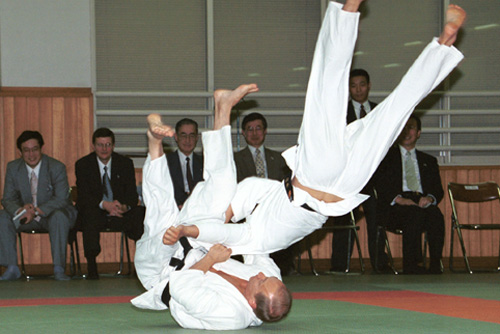
Pondering over who named "Yavara Neva" to the Sankt Petersburg Judo Club, my guess inevitably hit on President Putin, Judoka himself, who is familiar with the Japanese word Yawara (=Yavara) , beautifully adding it to the Mighty River Neva. Yawara is a synonym to Judo.  An ideal Judoka is gentle in appearance but sturdy in spirit – a person of real resilience. During  the '90s the Japanese comics or anime titled Yawara was a super hit depicting a fashionable Judo girl. It was written by Naoki Urasawa, an award-winning cartoonist.

Reportedly Putin began practicing Sambo (a Russian martial art without weapons) first, then switched to Judo at age 14, under his coach and mentor Anatoly Rakhlin. He participated in competitive tours and secured junior national ranking and a senior championship. He kept a blackbelt ranking higher than 4th degree and 9th dan at Taekwondo. When his mentor Anatoly passed away in 2013, he mourned for him as his second father in sports and in life and awarded him a medal of honor. Currently Yavara Sankt Petersburg is managed by Arkady and Boris Rotenburg brothers, both Judoka, who are close to Putin. In 2000, Putin visited Kodokan Judo Institute in Tokyo and met the grandson of the institute founder and legendary Judoka Jigoro Kano (1860-1938).  Kodokan conferred Putin 6th dan grade after testing.

During the Eastern Economic Forum (EEF) held in Vladiostok in 2016, Japanese PM Abe, Mongolian President Khaltmaagiin Battulga and Putin went to see a Judo match, commemorating a centennial Vladiostok Judo club, founded by Vasili Oschepka, the above mentioned Sambo founder. Oschepka trained at Kodokan and was the first Russian dan ranked Judoka under Jigoro Kano.

Sitting together with two presidents, Putin and Battulga, both blackbelt Judokas, PM Abe joked that he would like to see them do a demonstration match. Since Abe does not practice Judo, he would gladly and quietly sit on the side and enjoy the match.  The joke was ignored but PM Abe's reference to the all Japan Judo Federation Vice Chair Yasuhiro Yamashita, who was the 1984 Olympic Judo Gold Medalist and 8 year unbeaten National champion, culminated in an unusual armor-clad warrior match, held in Kodokan, Tokyo in Sept 2017 (see article).

Russian Judo progress has been remarkable, thanks to President Putin's personal pitch and involvement, as evidenced with the recent Olympic medal rush of Gold, Silver and Copper in Sochi and Rio de Janeiro for both men and women. I look forward to seeing how they will perform in the upcoming Tokyo Olympics.

Thursday, October 25, 2018

My Grandson, the Eagle Scout

A proverb says “Grandchildren restore our zest for life, and our faith in humanity”. Tonight, I’m speaking of my grandson who, last month, celebrated 1) his 15th birthday, and 2) achieved the rank of Eagle Scout from the Boy Scouts of America, or BSA, headquartered in Irving, TX. His name is Raymond Warner, but he has the same name as his father, grandfather, and great grandfather, so we simply call him Ray 4. He proudly kept the Raymond family Eagle Scout tradition by becoming the third generation Raymond Warner to become an Eagle Scout. The first Raymond Warner was just a little too old when BSA was established in the United States in 1912.

I fondly remember Ray Jr., who passed away two years ago last May. He was a veteran B-25 navigator-bombardier during WW2, and with the GI bill, graduated from Carnegie Tech University in Pittsburgh. Since meeting him at my daughter’s wedding, we became good friends and his close kin, sharing our mutual grandchildren.

Ray 4 is over 6 feet tall, so he must be taller than any of us here in this room. I haven't seen him since he was in the 3rd grade, when he was 8 years old. I’m sure his voice has changed, I hope to hear his low and sonorous tone overlooking me when we meet next spring on his school excursion to Japan.

Ray joined the Cub Scouts when he was 7, then seamlessly joined the Boy Scouts, where he climbed up the ranks from Tenderfoot, Second and First Class, Star and Life, then finally completing Eagle before his 15th Birthday. This is quite an achievement, as only 4 % of boys ever finish Eagle Scout, and where he lives, boys typically finish just before their 18th birthday. Raymond had to complete 21 merit badges on such topics as citizenship, camping, first aid and cooking, as well as activities like rock climbing, metal work, and rifle shooting. He has actually completed 28 merit badges, which qualified him to earn a bronze palm that he can wear on his Eagle Medal. One of the major requirements to complete the rank of Eagle is to plan and lead a significant service project. Raymond’s project involved over 30 people working more than 200 labor hours to build two steep staircases in the side of a hill at a brand-new local community park called Sapwi. The park now has more than 5 miles of hiking trails used by Ray 4’s high school cross country team, a bike course, a tournament level disc golf course and playground. The park opened at the end of September.

Ray 4 had to show, in all assignments, initiative, discipline, leadership and communications ability from planning to execution. He really pushed hard on this project to make it happen. I feel that this system is similar to what we do at Toastmasters. For your information, the Scout Law reads A Scout is Trustworthy, Loyal, Helpful, Friendly, Courteous, Kind, Obedient, Cheerful, Thrifty, Brave, Clean and Reverent. These are universal values and I’m all for them. Scouting can be found in over 100 countries, including Japan which had 100,000 members in 2017. USA BSA alone amass 6 million members. I’m proud to share with you my grandson’s Scouting achievements. I look forward to telling you more about him in the future.

Sunday, October 14, 2018

Russia Part 1

The 2018 Summer FIFA World Cup hosted by the Russians gained worldwide praise. Both Russia (Group A) and Japan (Group H) advanced to knockout stage, our mutual fairy tale expectations fueled up, eyes drawn to hot games at 12 modern Russian FIFA Stadiums, including Luzhiniki and Spartak in Moscow, Zenit Arena in Sankt Petersburg, Kazan, Kaliningrad, Sochi, etc. The results were not as good as Russia and Japan expected, but we surely enjoyed the thrill, passion, emotions and we have fallen in love with Russia, I’m sure. I’m glad that I found Zenit Arena Stadium completed in 2017; it was designed by the late Kisho Kurokawa, one of my favorite Japanese architects, the first sign a Japanese was involved with Sankt Petersburg infrastructure. Kisho passed away in 2007, so he didn’t see the completion of the project. Kurokawa built another FIFA class stadium – in Toyota City in 2001 in Aichi Pref and Oita City (2002) in Japan, a kind of sister stadium to Zenit Arena.

I refer to the Web site of “Transstroy”, the general contractor for the Zenit Area or Piterarea. It is stated there that "the idea of the stadium-attraction of global scale with maximum application of high technologies and progressive design is laid in the conceptual basis of the stadium laid by architect bureau Kisho Kurokawa Architect & Associates. We saved an innovative architectural concept and adopted it according to the last security requirements. " Please visit this site and enjoy the photo library and 3D-Tour.

The site has ticket information, as well as hotel recommendations – lots of information in English. Zenit Arena is located on the western tip of Krestovsky Island, north of Vasilyevsky, the biggest Island in Neva River, 7.5km away from the Palace Square. The nearest Metro Station is Krestovsky Ostrov on the purple line 5 which runs from the city center. Mind you, a little exercise awaits you. It is a 25-minute walk from the subway station through Maritime Victory Park, sport venues for tennis, polo, sailing, etc.

It was the summer of 2000, the turn of the century, when I visited Sankt Petersburg as a solo traveler. I depended on a Russian friend who speaks English, introduced by my Lithuania-born friend in San Diego. He agreed to the task but responded to me late. His entire family went to "datcha" near Moscow and returned to Sankt Petersburg just a couple of days before my arrival. Even in the worst case scenario, I didn’t mind spending my 10 days solely on the visit to the Hermitage Museum. However, to my big relief, I received confirmation close to my departure. He greeted me at the Pulkova Airport, gave me a complete “how-to-ride their Metro” (subway) guidance, showing me most of the famous sightseeing spots the day I arrived.  I was able to use the Metro with a few mishaps and without interpreters.  He took me one day to Peterhof, Peter’s Summer Palace & Garden, 25km west of Sankt Petersburg, with his friends. That was a truly great gift he gave me. The site has 1,500 acres and close to 200 water fountains.  It was a gorgeous garden!

I talked recently with a Japanese friend who claimed he had traveled to Sankt Petersburg over 10 times since 2005.  He said he visited Engllsh Toastmasters there and I couldn’t believe it.  He sent me the Web site to prove it.

He is promoting Russian Language Toastmasters in Saitama, Japan and I congratulated and wished him success.

Many Japanese corporations, particularly automobile manufacturers, Toyota, Nissan and Suzuki are in Shushary, Sankt Petersburg and thousands of Russians are employed there. Next should come what we call "a group clustering" of industries related to automobiles and the number of Japanese expats will increase.

Thursday, August 16, 2018

Iizuka reached Silver Jubilee

Amidst the Iizuka Silver Jubilee entertainment - sing alongs, vocal duo, and flute play, some members made this incredible, impromptu yet previously scheduled FaceTime computer connection in English from 8500 kilometers away.  Mama Mia!  it’s Copenhagen calling Iizuka.  A young man talking to Iizuka members on the computer was a Vietnamese engineer, who upon graduation from Kyushu Tech, Iizuka Campus, started working in Denmark a few years ago.  It was the highlight of the party!

Kyushu was new to me 25 years ago and I owe the name “Chikuho” (collective name of cities, once flourished coal basin in central Fukuoka Prefecture such as Iizuka, Tagawa, Nogata) to Rob Duncan, a Canadian Toastmaster (TM hereafter) whom I called on in Winnipeg after I attended the TM Chicago Conference in 1999.

All I knew about him then was he spent some years at Aso Hospital, Iizuka  teaching English to hospital doctors and nurses, and in 1993 started Iizuka TM Club during his stay, 4-1/2 years ahead of Kitakyushu TM Club, which Albert Moe, retired Boeing TM and I, also retired and a returnee from the U.S., co-founded.  My curiosity was how Iizuka, far smaller city than Kitakyushu, could launch a club so easily with speed and success.  My visit gave me a glimpse of his passion and personality, and in addition, the  indigenous motivational temperament of Iizukans.  

Chikuho has an old history, like Yamato (ancient Japan). Troops exploited Chikuho rivers as its Kyushu outpost to send reinforcements to help Kingdom of Baekje in Korea.  In 1700, when the Dutch trading post was set up in Nagasaki, Iizuka (including Uchino, now incorporated into Iizuka) served two traveling stations between Nagasaki and Kokura (Kitakyushu) and further to Edo (Tokyo) through Tokaido.   Coal had been rumored since Tokugawa Shogunate, but it was right after the Meiji Restoration that Chikuho became a coal mine mecca.  Numerous tycoons were born, like Aso, Yasukawa, and Kaijima.

The Aso Hospital Rob Duncan worked for is an off-shoot of the Aso enterprise. In its heyday, Chikuho produced half the nation’s demands, and supplied Yawata Iron & Steel Mill in Kitakyushu since 1901, using the same rivers to transport coal.  As in the Yazoo Delta field horror invented Mississippi blues, the “tanko bushi” (coal miners folk song/dance) hit Chikuho and beyond around 1930.  “The towering chimney should choke/smother moon, heave ho”.

The golden age didn’t last long. It’s negative legacy haunted Chikuho soon and Iizuka population declined 40%.  Iizuka, with the help of coal tycoons, tried their absolute best to get on a roll and bounce back.  Necessity had spoken. Today we see their fruits in high tech institutions such as 1) Kyushu Institute of Technology whose main campus is Kitakyushu; 2) Kindai University, molecular engineering institute and biological & environmental chemistry departments. whose main campus is in Osaka. These campuses boast 5000 students and faculties combined.  The above mentioned Aso Hospital reports over 300 doctors and 2500 employees. Aso Hospital is associated with University Pittsburgh Medical Center and Maryland Anderson Cancer Center.  A civilian initiative called Iizuka International Friendship has enabled young exchange students to go to Sunnyvale, California every year, encouraging study of English. Iizuka had a sense of urgency far better than Kitakyushu.

This year Iizuka TM club celebrated its 25th Anniversary and I was invited by  Pres. Hiroshi Nishiyama, ACG & CL.  I’m glad to return to Iizuka, expecting to see the now verdant slag heaps I missed for years.  Meanwhile I contacted Rob and Naoki Tsukamura (ex-Toto engineer, Kitakyushu and one of the founding members).  It was Tsukamura who introduced me to Duncan, as the blazing fire whose departure was regretted by all with tears. Both men complied and I read their messages for them.  Below, however, I’m citing Founder Duncan’s message.

"Congratulations on your 25th Anniversary, Iizuka Toastmasters. That's wonderful!! I recall the Charter Presentation for Iizuka Toastmasters at Cosmos Common on October 16th, 1993. Toastmasters Tadokoro and Oishi, Members of Fukuoka Club, gave us official guidance during the charter process.

Mr. Akiyoshi was the first President of Iizuka Toastmasters Club. I served as Toastmaster of the Evening at the Charter Meeting. The Charter Presentation was done by TM Evans, our area Gov. from Kadena, Okinawa. Interestingly, Mr. Evans had met Dr. Ralph Smedley, who established the world's first Toastmasters Club in California in the year 1924. I was honored to attend the 10th Anniversary of Iizuka Toastmasters in 2003. And now it is 2018. Where did the time go?

Recently, I fell and broke my hip. Since my hip has been fused for over thirty years, it is difficult to receive standard hip repair surgery. Therefore, I have a long wait for natural bone growth. During my recuperation, it is nice to know that Iizuka Toastmasters has reached the 25 year milestone.

Thanks to all who have participated in the Iizuka Toastmasters experience. I would like to make special mention of members who have been with Iizuka Toastmasters since the early years. I admire your patience, persistence and positive attitude.

I remember visiting long-time member TM Hirata at his Hokka Hokka Bento shop and discussing Toastmasters. During our conversations, I recall enjoying Unagi barbecued eel bento!  Fond memories ... Natsukashii.

I would like to close with a little story.  In Iizuka, I used to visit a bonsai shop on Shin Iizuka Eki Dori (street). The beautiful little bonsai were very interesting to me. I recall the shop owner collecting moss (koke) where it grew near the streets. He used the green moss with bonsai displays.

Moss makes me think of lichen, L-I-C-H-E-N (pronounced like - en).  Lichen is similar to moss. And the word lichen brings to mind a quote from the English writer John Ruskin, who lived from 1819 to 1900. Coincidentally, this quotation comes from "Essays by John Ruskin...", published by Charles Scribner's and Sons in 1918 -- exactly one hundred years ago!

'...among the mountains the silver lichens rest, star-like, on the stone; and the gathering orange stain upon the edge of yonder western peak reflects the sunsets of a thousand years.'

Lichen makes me think of longevity. Now, I reflect on the longevity of Iizuka Toastmasters -- a quarter of a century. 25 years of memories. Arigato. Thanks for the memories."

Monday, June 4, 2018

Matsura Sayohime

Japan and Korea face each other across the Tsushima Strait with only 200 kilometers of distance between them. Their relationship goes back to prehistoric days. Japan was close to the Kingdom Baekje, through Buddhism, between royal families.  During the 6th Century, Baekje was invaded by the neighboring Silla Kingdom, allied with the Tang Dynasty of China. Despite the sign of impending downfall, Japan sent reinforcements upon Baekje’s desperate request according to Nihon Shoki, the second oldest history book of ancient Japan. Tang’s ships waiting at Baekgang inlet dispatched Japan’s ships in no time, leading to the demise of the Baekje Kingdom.

The defeat brought panic to Japan.  The thinking was that Korea and China allies might invade Japan soon. Japan garrisoned soldiers at strategic posts in northern Kyushu, and named Dazaifu the key fortress.  Many men were conscripted to the remote bordering posts. Sad poems were written of those garrisoned soldiers away from their homes in a Manyoshu Anthology, the first written form dossiers compiled by our ancestors.

Manyoshu has also featured poems sung for Matsura Sayohime, a local maiden who fell in love with Satehiko Otomo, destined for Baekje from Karatsu beach. Satehiko gave a beautiful mirror to Sayohime, saying “Please hold this as if this is me”. When his boat was leaving, Sayohime climbed up Kagamiyama Mountain, shouted his name, waved her Kimono sleeves. She chased after the boat, crossed over the Matsura River, reached Kabeshima Island. She eventually became paralysed due to her deep sadness.

Two Manyo poets who sung for Sayohime were Tabito Otomo, related to Satehiko and Dazaifu Governor General, and Okura Yamanoue, Chikuzen Governor.  Okura reportedly immigrated to Japan from Baekje accompanied by his father when Baekje perished. He is one of my favorite Manyo poets. This Sayohime story became popular through Manyoshu. About 500 years later, Noh Master Zeami wrote a Noh play based on it. However, it was forgotten until recently to be rediscovered and I’m happy to report that I recently saw the Sayohime Noh play in Fukuoka.

The month of April also saw the historic breakthrough of hostility between two Koreas, South and North and declaration of peace and denuclearization. We, the Japanese, wish to see the kidnapped Japanese by North Korea soon returned for long awaited family reunions. 

Learning:  Sorrow, at any age, is immutable, today just as in the olden days.