Monday, September 22, 2014

The Vietnam War Remembered

Rest well, my child of the yellow race
I'll rock you gently
and heal your gun wounds
You went to war at the age of 20 years
Never returning home
Sleep, my child, sharing my yellow skin
I'll lull you and coax you
I'll do it twice
This body
which used to be so small
that I carried in my womb
that I held in my arms
Why do you rest at the age of 20 years?

"Lullaby" (Ngu Di Con) by Vietnamese Lyricist and Composer Trinh Cong Son (1939 - 2001), about a mother grieving her son who has gone off to war, became a hit in Japan in 1972. When he died at the age 62, he was dubbed the Bob Dylan of Vietnam by American singer Joan Baez. He gained fame in the 1960s for his love ballads and anti-war anthems, and has just been posthumously awarded a 2004 World Peace Music Award (WPMA), alongside other well-known names such as Harry Belafonte, Country Joe McDonald, Peter, Paul & Mary and well, Baez and Dylan.


Da Nang in Central Vietnam was my next stop after visiting Hochimin. The distance between Hochimin and Da Nang is about 1000 km. I found Da Nang Airport as unboundedly open and shining, contrary to my preconceptions from the stained image of the Vietnam War. Yes, a modern city with good roads and bridges. I was met by a taxi driver sent from my Hoi An hotel at the airport exit and sped south after clearing city traffic along the beach with luxury hotels and condos and golf courses. The scene looked familiar. This is Southern California!
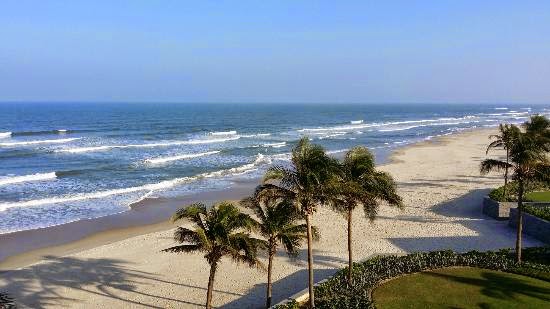
I've read that the US Marine Corps Battalion Landing Team, wearing full battle gear and carrying M-14s, met Vietnamese girls with leis, South Vietnamese officers, sightseers, carrying a large sign "Welcome, Gallant Marines", and General Westmoreland was appalled. I was similarly baffled with the "Southern Cal scene” in Da Nang, Vietnam.

I am glad that I dropped Hue, the old capital, from my itinerary. Heading north, you have to dash up Hai Van Pass and necessarily touch upon the 1968 Tet Offensive related Hue massacre. Hue is where Trinh Cong Son, the "Lullaby" composer, lived.

Reachable from Hue are many historical US versus NVA battlefields (Khe Sanh, Con Tien, etc) on the 17th Parallel DMZ where the US had tried to block NVA infiltration into the South through Ho Chimi Min Trails, as well as the Vin Moc Tunnel Complex, which was dug deeper than the US bombs could penetrate. More than 400 villagers survived the war and more than 40 new babies were born underground. However, they could have been victims of Agent Orange, the defoliants.

I was stationed, as a Japanese businessman, in the U.S. during the Vietnam War and saw nationwide upheaval, anti-draft hippies and anti-war student marches.

I remember David Halberstam, in Saigon, as a New York Times correspondent. He was among a small group of American reporters who began to question the official optimism about the growing war in Vietnam. The Communist government in the north enjoyed wide spread support in rural Vietnam. The US-backed Saigon Government was quite unpopular. Halberstam saw Vietnam as a moralistic tragedy, with America's pride bringing about the government’s downfall. Although he won a 1964 Pulitzer Prize for reporting, he was transferred to another bureau.

I safely chauffeured David Halberstam to Kearny Mesa when he flew into San Diego Airport. He visited my former employer's plant to interview the company’s founder Kazuo Inamori, who happened to be visiting San Diego at the time. Halberstam was preparing for his 12th book "The Next Century" and found Inamori's nickname Mr. AM quite intriguing.

Halberstam taught that the moment humans lose their modesty, it inevitably leads to hubris and arrogance resulting in the demise of everything. Kazuo Inamori, who later read "The Next Century", warned his employees to "avoid paved ashphalt roads” and not “be afraid to take dirt roads."

I wrote that I drove Halberstam "safely." In 2007, David Halberstam was killed in an unfortunate traffic accident in Menlo Park in a car driven by a Berkeley student.

Jack Langguth (unusual surname so I remember it well) succeeded David Halberstam at the Saigon NY Times Bureau. Jack was sympathetic to David. When I did a search on him, I was surprised to see his obituary a few days ago. It was Sept l, the day I came home from my Vietnam trip. He was 81. We are of the same generation. After retiring from the New York Times, Jack taught journalism at USC in Los Angeles. He not only wrote books about Vietnam, but history and children books as well.

I wish to dedicate this blog entry to all those who perished during the Vietnam War and to David Halberstam, Jack Langguth, and Vietnam pacifist composer Trinh Cong Son.

Tuesday, September 9, 2014

A Brand New "Tung Son Thach" Japanese Garden in Hochimin, Vietnam

"She was crammed in by a boatload of human bodies, thinking of her father and becoming overwhelmed, slowly, with loneliness. As much loneliness as fear. Concentrate, she told herself. And she did ― forcing herself to concentrate, if not ― if she was unable to ― on the thought of her family, then on the contact of flesh pressed against her on every side, the human warmth, feeling every square inch of skin against her body and through it the shared consciousness of ― what? Death? Fear? Surrender? She stayed in that human cocoon, heaving and rolling, concentrating, until it was over."

- from Nam Le's The Boat (2008), which won the Dylan Thomas Prize

Nam Le, as a baby, was smuggled by his parents from war-torn Vietnam on a tiny boat, which landed in Malaysia and then found refuge in Australia. After graduating from the University of Melbourne, Le worked as a corporate lawyer and also started writing stories and sent them to the U.S. In 2004 Le attended Iowa Writers Workshop which taught him to concentrate on creative writing. His first book, The Boat, has 7 short stories, including my favorite "Hiroshima", dealing with a girl orphan named "Little Turnip." Today, Nam Le is a rising star.

So was Ngo Chanh, Chairman of Shoei Trading Company, the Vietnamese protagonist. His boat headed north for Japan, instead of Malaysia. Chanh, was probably in his late teens then, as he was born reportedly in the zodiac year of the wild boar. He landed in Tokyo and the Tokyo Association of Refugees transferred him to Matsuyama City, Ehimeken, my birthplace, where he got local support and shelter. There he first engaged in shipping secondhand fishing boat engines to Vietnam on a small scale and gradually expanded his business to bigger machines and vessels. As he succeeded, he returned to Hochimin, Vietnam in glory to manage plastic treatment factories in Hochimin, Vietnam. It took him more than 30 years of perseverance and hard work.

What amazed me was the construction of the Japanese Garden "con vien Rin Rin Park" near his plastic plant of about 5 acres (7000 tsubos), which opened early in 2014, 20 km northwest of Hochimin, an area called Hoc Mon District. I have a Japanese friend living in Hochimin who is a Japanese language teacher. She brought me news of the garden since she knew I was involved in the San Diego Japanese Garden. She had been in San Diego before Hochimin. She made an arrangement for me to interview Ngo Chanh on my recent Hochimin visit.

Accompanied by his son Ngo Kim Thuan, sharp-looking and debonair Ngo Chanh appeared before me at about the time Dinh Vuong (student of my friend who guided me to the park) and I finished the tour of his garden. Both father and son are fluent in Japanese.

Ngo wrote down his Matsuyama address in his impeccable Japanese Kanji. Doidacho was his address. We talked about common topics of Matsuyama. Doidacho is southwest of Matsuyama Castle, not so far from Matsuyama Shieiki, once the home of the Iyotetsu "Botchan" trains. Doidacho is the 2nd station on the Iyotetsu Gunchu Line from the Matuyama Shieki. There are sporting facilities for Matsuyama citizens such as a swimming pool, martial arts stadium, cycling track, etc. where the famous Ishite River joins Shigenobu River in southern Doidacho. His son, who graduated from the nearby sports loving Yushin Junior High, must be very familiar with those facilities.

Ngo Chanh was motivated to build the Rin Rin Japanese Park to show gratitude to Japan as well as to introduce the true Japanese culture to fellow Vietnamese. He therefore paid enormous freight, transporting 4000 tons of Japanese stones, including "Iyo" blue stones, "Uwajima" sperm-whale stones, Mikame-cho stone walls, Oshima-made stone Pagoda, drum stone bridge, stepping stones, stone lanterns, sculptured stones; 50 thick needle podocarp trees ( Podocarpus macrophyllus) and 20 pyramidal junipers (Kaizuka-ibuki) and Imabari gravel, per Yasuhito Kido, President of Ehime Kenjinkai in Hochimin.

In addition, he airfreighted 200 varicolored golden carp from Konishi Farm in Hiroshima. He hired Kiyohiro Takahashi, a professional gardener born also in Iyo-shi, Ehime, a year after ground breaking. The park, called "Tungson Thack Pak" (meaning Matsuyama Stone Park) in Vietnamese, officially opened in March with 1000 well-wishers in attendance. Ehime Governor Nakamura visited the park before the official opening and thanked Ngo for his fantastic conception and power of execution.

Looking at a map online, I expected to easily find the park, but in reality it is hard to locate. I circled around the crowded housing area for a quarter of an hour searching for it. The park is further west of Tan Son nhat Airport. I saw the Vietnamese ad pamphlet upon my visit. The "Cong vien da nhat ban" appearing on the pamphlet stands for the Japanese style stone garden. Its notoriety gradually spread by word of mouth. I was quite obsessed with pictures and knew what to expect, but standing in front of the central stone themed landscape, "spirit of stone" and "spirit of tree", I felt quite at home, serene and exhilarated and wanted to congratulate Ngo for his dream-come-true project.

He is planning to open up the park for Japan-Vietnam Friendship, Trade and Exhibition activities, attracting Japanese visitors and I'm sure it will be further developed for fun, leisure and entertainment.

Note:

Finishing this Rin Rin Park blog, I found that the pine trees were symbolic trees of the Ngyuen Dynasty, the last ruling family of Vietnam, whose capital was in Hue, near Da Nang, Central Vietnam, from 1802 to1945. The French invaded in 1858. Ngyuen Dynasty lasted until 1945, although it was under French protection and influence. I read that many of the Ngyuen Dynasty pagodas and royal tombs have rows of pine trees. "Matsuyama" (Mountain of Pine Trees) also means special fate and the park symbolizes Ngo Chanh’s second hometown.

Visit the park's facebook page.

Sunday, August 10, 2014

Fukuoka 60th Anniversary Part 3 - Women Leadership

A few weeks ago, the paper reported that the Church of England voted to allow women to become bishops for the first time in its history. It's hard to realize that sexual discrimination still existed in the Anglican hierarchy, as I know quite a few women have been ordained in ministerial positions. It’s surely a welcome and overdue change.

Helen Blanchard
Today our Toastmasters Worldwide Organizations boasts 100 Districts. Of the 100 District Governors, men and women governors are split 50-50, equally and ideally balanced. Toastmasters International has come a long way,

It was 1970 when Helen Blanchard applied for a membership with the San Diego Naval R&D (her work site) Toastmasters chapter. The club may have been willing to let her in but Toastmaster headquarters’ position banning women hadn’t changed then. When local members submitted her application, her gender was disguised by turning the first name to Homer.

Toastmasters then quickly made an about face and ruled it gender free. Helen advanced up the ladder and in 1985 she was the first woman International President. I attended San Diego Toastmasters Convention but my official Toastmasters membership was after 1994, the year of my retirement when I left San Diego. I know and have seen Helen from a distance but missed the chance to talk with her in person.

Yoshiko Mohri

Upon visiting Fukuoka Toastmasters on my return to Japan, I found Yoshiko Mohri, as the 'Helen Blanchard' of Japan. She joined Fukuoka Toastmasters in 1972, probably one of the very few women Toastmaster trailblazers back in the pioneering days. Fukuoka can compete well with San Diego when it comes to history of women leaders. DTM Mohri held her membership for over 40 years to date without any interruption. She saw Fukuoka club’s 20th, 30th, 40th, 50th and 60th anniversaries!

At the recent 60th Anniversary, I asked her if she was the first woman joining Fukuoka. “No, I was not the first,” was the immediate response. She showed me a photo static copy of the 20th Anniversary where I counted a dozen women. “Fantastic! In 1974, you had a dozen women members out of 20.” “Oh, I remembered a women college professor member brought some of her students… Of all the women members, I might have been the 5th”. In 2006, DTM Mohri served as District Lieutenant Governor for Education/Training, and in 2013 she chaired the D76 Fall Convention in Fukuoka.

I’m impressed with her knowledge and cool application of adult techniques, yet she is considerate with business-like-contacts and responses and full of common sense. Perhaps they are gifts from her travel related trade experiences. Once, she and I had a chance to greet our mutual Taiwan Toastmaster friends in Fukuoka. I liked her excellent choices of restaurant and the entertainment.

Shoko Akie
I pursued with persistence whom she could identify as Fukuoka women leaders like her in the past, serving as officers such as VPs and Presidents. Three names were given: Chieko Kawashima in the 1960s - 70s, Shoko Akie in the 1965 - 76 and Mitsuko Nishimura, later in mid 1980s - 90s. I could not find any records regarding Chieko Kawashima whom other members remembered as a hard worker, always cheerful and friendly. Shoko Akie (born in 1920) is Professor Emeritus of Fukuoka Women's University, holder of the Government’s 3rd Order of the Sacred Treasure for her lifetime contribution to women studies and gender equality campaigns. She authored a book comparing two distinguished educators, Horace Mann (1796-1859) and Yurei Mori (1847-1889). DTM Mohri is proud of such high caliber women as members of the Fukuoka Toastmaster. I know the late Mitsuko Nishimura well because she, Albert Moe and I co founded Kitakyushu Toastmasters in 1997. Mitsuko commuted from Kitakyushu to Fukuoka by train then. I will feature her on a future blog post.
Chieko Kawashima (third person from right)

Monday, July 28, 2014

The Edo Japanese artists Keiga & Hokusai and P.F. von Siebold

Philipp Franz von Siebold (1796-1868), a German doctor, who studied zoology, botany, and ethnology, plus earned a doctorate in surgery, obstetrics and internal medicine, prepared to leave in 1828 for Europe after a stay of six years as physician at the Dutch East India Company Dejima Factory, the only trading post authorized by the Tokugawa Shogunate.

His belongings became wet dampened during a storm, and when laid out on the deck for drying, discovery was made by a Nagasaki Magistrate official of banned maps of Japan drawn by Tadataka Ino, and a Haori jacket with a hollyhock crest of the Tokugawa family, etc. During the intensive investigation that followed, Kageyasu Takahashi of the Nagasaki Magistrate, who had given the maps to Siebold, was sentenced for capital punishment. Genseki Habu, the Shogunate doctor responsible for the Shogunate Haori, was deprived of his post, and Siebold was exiled for life out of Japan.

Implicated in this conspiracy were more than 50 other Japanese friends, doctors, interpreters and tradesmen who were punished as grave criminals. Choei Takano, who was a leading disciple of Siebold, was also a victim, but fled with luck. This is known as the Siebold Incident.

Toyosuke Kawahara (1786-1865) was another victim who was punished and disappeared from Dejima, along with his art teacher Yushi Ishizaki, who was the elite official Connoisseur of the Chinese Painting of the Nagasaki Magistrate. They were simply too close to Siebold. Their indictments were for such trivial matters as the family crests of the clans in guard at Nagasaki appearing in their art pieces.

Toyosuke was referred to Siebold by Yushi as a promising painter; Siebold was eagerly waiting for the arrival of Carl Hubert de Villanueve, a French artist whom he requested as an important reinforcement to his research crew in Dejima.

Toyosuke was hastily added to Siebold's entourage to travel Edo. He was to paint scenes of major towns and ports on the way to Edo from Nagasaki, and fauna and flora upon Siebold's request. Toyosuke learned through trial-and-error and delivered to Siebold's liking. He gradually gained confidence developing the genre, creating an east-meet-west style that not only met the scientist's demands, but deeply impressed Siebold. He eventually learned western oil painting from French artist Villanueve and applied these techniques to his figure paintings.

Most of the Siebold's collections, including 12,000 specimens, had been shipped out before the above scandal. Immediately upon his return from Japan, Siebold began sorting them and published books, first with his own money, later with the help of Leyden University and Dutch King William II. 'Bibliotheca Japonica', 'Fauna Japonica', 'Flora Japonica' came out mostly between 1830 and 1860, acclaimed as the "books of miracle". In addition to the text, 'Siebold Bibliotheca' has 367 lithograph illustrations, most of them based on Toyosuke's paintings.

About 1,000 of Toyosuke's paintings are now at Leiden University museum and Komarov Botanical Institute Museum in St. Petersburg, the largest collection of one of the great Japanese Edo artists in Europe. He is better known in Europe than in Japan.

Toyosuke (changed his name to Keiga Taguchi after the Siebold incident) painted Russian Admiral Yevfimy Putyatin when he visited Nagasaki in 1855 on a diplomatic mission. Also, he signed the portrait of Grandma Kiku Nagashma in Nagasaki, supposedly painted in 1860. We surmise he lived until 1860.

Meanwhile, with a pardon, Siebold returned to Japan in 1859 and met his daughter Oine, and stayed until 1862. It is doubtful that Toyosuke and Siebold were ever reunited.

While searching for the contemporary painters of Toyosuke aka Keiga, I found Katsushika Hokusai (1760-1849), 25 years senior to Keiga. Hokusai, is the one and only Japanese who was included in Life's magazine "Top 100 who Made the Millennium" for his "Ukiyo-e" woodprints, including "the Great Wave and Fuji". Do not be surprised if Keiga had something to do with Hokusai avoiding subrogation in the Siebold Incident.

Hokusai was approached by both the Dejima Dutch Captain (obligated to travel to Edo from Nagasaki every four years, like the Daimyos) and Siebold to do sketches of the daily lives of Japanese. The captain paid Hokusai at the contracted price but some quarrels were recorded between Hokusai and Siebold. Siebold demanded a discount and Hokusai refused. The dispute was settled when the captain heard about it through interpreters and paid Hokusai the full price. Hokusai’s works appeared on Siebold’s encyclopedic “Nippon”.

What about Hokusai's involvement in the Siebold case? Tokugawa banned the sale of his art work to foreigners. My question is: did the Hokusai deal precede the banning because the captain's names differed (the contractor versus the payer)? Keiga might have stepped in and possibly gotten Hokusai off the hook.

If true, what a laudable act it was to let the senior Hokusai churn out his world-class ukiyo-e during his twilight years.

Monday, July 14, 2014

Catalpa’s Spread in Japan, Grown from Seeds

It all started with the invitation from the Tokutomi Memorial Garden of Kumamoto. "Catalpa trees are in full bloom. Please join us for flower viewing with an ocarina music concert and other entertainment." I have wanted to see the Oe School remains where Reverend Sokabe studied (see Samurai Missionary post), so I decided on a visit.

After a 2 ½ hour bus trip from Kitakyushu, I finally arrived at the Garden. The original tree that the Tokutomi brothers planted fell victim to a typhoon but the descendant trees thrived well. The Kumamoto City homepage had photos of two catalpas from; l) nearby Idegawa river bank and 2) Hishigata Elementary School, 'Uekimachi.' Both are sibling catalpas more than 100 years old. In particular, the Hishigata School catalpa is 18 meters high and the trunk measures 336 centimeters in diameter and is noted as the tallest and widest tree in the report filed by Junji Imamura, a tree doctor, contracted by the voluntary group of Hishigata School students, supported by parents and teachers.

Junji Imamura also studied DNA of the nationwide catalpas and he discovered that they propagated from the same Tokutomi seedlings. The trees studied by Imamura included the ones in Kurume (Fukuoka), Isahaya (Nagasaki), Hiroshima, Aomori and other locations. I figured catalpa numbers in Japan to be around 100. However, when I searched under "Kisasage", the Japanese name, I counted more than 100 sites showing off their catalpa trees and flowers throughout Japan. There are trees in schools, parks, temples, and herbal gardens. Now, I have revised my figures to be in the thousands, including both species of Chinese and American catalpas. I think the Chinese catalpa is called "Jishu" but I could not verify it. Here is additional information about American catalpa.

I'm fascinated with the word "catalpa", which does not sound too American. I was right; it came from "Catawba", a Native American tribe of Sioux. There is the Catawba River in North Carolina, which flows into the Santee River in South Carolina and emptying into the Atlantic. My ex-employer had a plant close to the Catawba River, 70 miles west, so I know the area. There is some coal ash ecological residue in the Catawba River Basin today. The Catawba tribe is now settled in Rock Hill, South Carolina after their relentless land claims. Another Catawba tidbit is the mysterious Catawba worms! They are great fish bait that you can find on the catalpa leaves. The worms morph into sphinx moths.

Now the mystery is of how Reverend Joseph Niijima, founder of Doshisha University, came into possession of catalpa seeds. In the late 1860s, I read that there was a kind of catalpa craze that spread from New England, Ohio, Texas to California that seemed to be associated with the railroad industry. Reverend Niijima studied at Amherst, Massachusetts and he must have seen school children planting seedlings. Catalpa today is regarded as somewhat invasive, but back in the last century, not so. In less warm states, like New England, people had to take extra care and I read they rejoiced when catalpas were resuscitated under harsh conditions, likening catalpa as a phoenix.

Getting back to Hishigata Elementary School, the school slogan is, "We have the No. l Catalpa of Japan, the symbol of the Niijima/Tokutomi bonds of friendship between teacher and students. We will strive to be No. 1 in sports, in greening of the school and soaring high as we enter society." Hishigata School Baseball team won the local baseball competition in 2013.

Note:

Here is a note I received from my friend Don:

I received a question on trees which are in USA and Japan. I am gathering information. They seem to like warm, wet weather and are not prevalent in the cold northern climates. I will check with my friend in South Carolina. Meantime I am also checking out an American city named AZUSA near Los Angeles. I believe it is a tree, similar to what Yokohama has for its main street, ISEZAKI-cho.

The history says Japan used it for the bow of the Samurai. In America, we do not have info on usage. But ISEZAKI tree is much like AZUSA word. And the BOW was very important with Algonquin (“Are Kan Quayn" to be the bow and flint arrow point - the original name for America before Columbus).

The Catawba tree had fruit that natives used for fish bait because they resembled worms. It is also called a "fish bait tree" in the Carolinas.

Near Alabama the Indians had an area named TUSKEGEE. The history says it may have meant "warrior". I think it relates to TSUKA in Japanese for "a mound". These people were also known as "mound builders" and these mounds of earth are seen in many places throughout the Midwest. It would be "Mound trees---Tsuka Ki ga".

Monday, June 30, 2014

60th Anniversary of Fukuoka Toastmasters Part 2: Dr. Masuda

Our paths finally crossed on the 60th anniversary of Fukuoka Toastmasters, after a number of prior missed opportunities. Right after group photograph for the event, we finally had a chance to talk. We found we had both lived in New York in the 1960s. He was a Fulbright Scholar at Sloan Kettering Institute from 1966 to 1969 researching carcinogens. I was a liaison expatriate working in Manhattan for a Japanese electronic manufacturer during most of the sixties. I mentioned the name of the Rockefeller University in the Upper East Side and he said Sloan Kettering is in the neighborhood.

His name is Yoshito Masuda, Doctor of Pharmacy, now retired from the Daiichi Yakka Daigaku, a private College of Pharmaceutical Science, and a member of the Fukuoka Toastmasters between 1970 and 1980 and then re-enrolled since 2000 to date. I asked about Fukuoka Founder Usui and 2nd President Tadokoro. Dr. Masuda met both Fukuoka founders. Usui and Masuda lived in the same eastern Fukuoka neighborhood. I thought Usui relocated with his family from Fukuoka to Kitakyushu but I was wrong. On weekends Usui returned home and occasionally attended Fukuoka Toastmasters meetings. Per Masuda, Tadokoro served as president intermittently, for an overall period of approximately 5 years. Tadokoro, as a phonetic specialist, was strict in pronunciation. Masuda, himself, also served as president in 1980 before he went on furlough with Toastmasters as his work got busier.

In 1986, Dr. Masuda received a call to organize a convention, which would demonstrate his numerous abilities and experience - his dioxin expertise, a grant offer from his University, and Toastmastering and logistical skills. The Advisory Board to the International Symposium on Chlorinated Dioxins and Related Compounds chose Fukuoka Japan as the 6th convention venue and touted him as the Chairman of the Symposium. The venues prior to Fukuoka included Rome, Washington, DC, Salzburg, Ottawa and Bayreuth (Germany), all prominent international cities.

Fukuoka was chosen first in Japan, well ahead of Tokyo (2007) and Kyoto (1994), for two special discussions: 1) Japan presented the Fukuoka "Kanemi" rice oil poisoning paper in Rome (the 1st Symposium) and the name Fukuoka was remembered by the Advisory Board; and 2) scores of papers were presented on the Agent Orange aftermath from the Vietnam War, which attracted many participants.

Dr. Masuda presided over the symposium for four days at the Nishitetsu Grand Hotel where 280 participants assembled and presented papers. Two hundred were foreign participants and 80 were Japanese. He recalled the heavier proportion of foreign participants impressed the then Nishitetsu Grand Hotel Manager, as the opposite was generally observed, i.e. overwhelming Japanese attendees in most international conferences in Fukuoka during the ‘80s. The alerted local TV stations highlighted the conference and Dr. Masuda gave an in-depth interview.

In 2004, Dr. Masuda received an out of the blue invitation to Kiev, Ukraine, together with German and American doctors. Facing election, Viktor Yushchenko, 3rd President of Ukraine, was entertained by Russian officials at a Sushi bar. After dinner the face of Yushchenko showed severe chloracne, although no symptoms appeared on the Russians. Apparently Kiev worried for the President and a committee was formed, inviting dioxin specialists, to understand what care and caution might be needed in the future. (Currently relations between Russia and Ukraine are delicate.) He could not share more details. I'm proud that Fukuoka Toastmasters has a world-class scholar on dioxin, depended upon worldwide.

Monday, June 16, 2014

60th Anniversary of Fukuoka Toastmasters

Fukuoka Convention you hosted last year won the nation's Toastmasters recognition as the pan-Kyushu’s conning tower, including the bordering prefectures.

I salute you and your dedicated corps of volunteers. You were the salt of the earth throughout the convention. My wife, unfortunately, had her knee meniscus damaged and we were only able to attend on the final day. However, I planned a quixotic challenge of honoring, in vain, Fukuoka Founder Usui, the first Japanese Toastmaster behind the scenes. I'm not going into the inside story tonight. DTM Mohri, who chaired the Convention, knows the details.

TM Usui was the founder but he left Fukuoka shortly for Kitakyushu when he was hired to be on the faculty of Kitakyushu University. He left everything to the 2nd President Tadokoro. It was President Tadokoro who took on the gritty job and faced the full consequences. TM Tadokoro and I both are hearing impaired and as the proverb says "Fellow sufferers pity each other."

TM Tadokoro and I exchanged letters often and he sent me books he wrote. He reminisced about the great honor of being invited to the 80th birthday of Dr. Ralph Smedley in Santa Ana in 1957. He also confided to me that he felt relieved from the heavy burden entrusted on him by Founder Usui. He was happy to have kept his pledge to Founder Usui, a great episode of Fukuoka Founders.

In closing I wish to pay tribute to the Founders quoting TM Tadokoro's essay titled "A Road to Authentic Speaker."

"Strain your eyes in uttering any one word, uttering the first word and the stressed one of a sentence. It is the way you depart from the borrowed language and make it of your own."

May both founders rest easy now, assured that the group they founded will strive to continue the tradition of excellence they established.