Showing posts with label Joanne Oppenheim. Show all posts

Sunday, February 27, 2022

US-Canadian Borders: My Connection

This morning paper surprised me as I was familiar with all the names and locations in the article. It read as follows:

It was about the Canadian borders with the U.S (truckers freedom convoy) in Canada.

The three border crossings are:

  1. Coutts, Alberta, to Sweet Grass, Montana
  2. Emerson, Manitoba, to Pembina, North Dakota
  3. The Ambassador Bridge at Detroit and Windsor, Ontario

First, about the Coutts border. In August 2008, my son-in-law Raymond Warner III (the 3rd) and I attended the Calgary Toastmasters International Convention. On the way to Calgary, I was scheduled to do a presentation at the Japanese Canadian Museum in Burnaby, neighboring Vancouver City, British Columbia, about my Japanese translation of Joanne Oppenheim’s “Dear Miss Breed”. In fact, I was to deliver a dozen translated books to the museum signed by me for the readers gathering there. I thought I had enough time to travel in a rented car, from Vancouver Airport to Burnaby, but an unusual delay at the Canadian customs clearance made my arrival at the museum half an hour late.

I apologized to my audience of 30 people waiting for my arrival. Thankfully, the event went off well.

Raymond and I then drove to Banff (probably my 3rd visit) to the Calgary Toastmasters Convention where TM Kiminari Azuma was representing Japan as a D76 speaker and I wanted to cheer him on.

Raymond's Google direction in 2008 read as follows:

From Calgary, drive down 180 miles south, about 3 miles, take Blackfoot & Deerfoot Trails SE, take Crowsnest Hwy E, Hwy-2 S, Hwy-3E/Red Coat Trail E toward Lethbridge, Card-stone/Fort Macleod, turn right at Hwy 2, now entering US-89.

Coutts is 60 miles southwest of Lethbridge. I was close to Coutts but Raymond and I didn't go through I-15. Raymond wanted to take me on a tour of Glacier, Yellowstone, Grand Teton-Mormon Row, Jackson, Idaho Falls, Craters of the Moon, (almost all are National Parks) before returning the rental car in Boise, Idaho.

I read that Coutts was a town of 250 mostly senior citizens, expanded further at Milk River, previously the site of an RCMP checkpoint. Now Coutts is the busiest port of entry for Alberta and Montana, seeing 800-1200 trucks pass through daily, and is critical to Alberta’s beef and meatpacking industry. The 'truckers freedom convoy' otherwise known as the anti-vaccine mandate protest has prevented hundreds of truckers from transporting their cargo across the Canadian-US border.

Next, about Emerson, Alberta. I visited my Toastmaster friend Rob Duncan in Winnipeg, Manitoba after attending the Toastmaster Chicago Convention in 2000. Rob was stationed in Iizuka City hospital, Fukuoka for a few years (near Kitakyushu). While in Iizuka, he installed Iizuka Toastmasters ahead of Kitakyushu. I wanted to listen to his motivation as well as background.

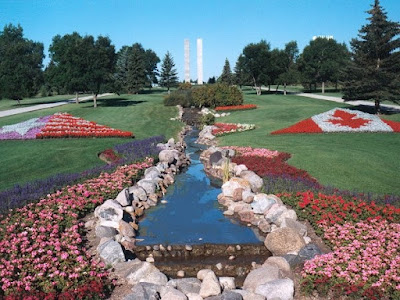
While in Winnipeg, I extended my trip to Regina to visit Verna Mitura, a Canadian friend I met at the Hino English Club. She represented the Canadian Government in agriculture, a career woman. First, I drove from Winnipeg to Regina straight and just saw nothing but wheat fields. So, when returning to Winnipeg, I took the border routes. I recognized Emerson on my return route. There was a huge International Peace Garden, located on the Canadian/American border near Boissevain, Manitoba/Dunseith, N, Dakota, where I spent a lovely afternoon. I traced border routes through Turtle Mountain, etc. and at Emerson/Pembina, drove straight up north back to Winnipeg.

Lastly, about the Ambassador Bridge and Detroit. I didn't see the Ambassador Bridge, but the name sounded familiar. It was Spring 1957. I was a lucky greenhorn fresh from college to accompany two 'big bosses' as their interpreter traveling almost all major US cities. Detroit then was a must-visit city for businessmen and that's where my Fulbright Professor McCormick taught - Wayne U! The doctor marked my English essay 99! When I telephoned, he was so glad to hear from me and invited me to his home for dinner. He told me that Detroit is the only city south of Canada at that crossing.

The article brought forth fond memories of my travels in the US and Canada and the border crossings, particularly with Raymond in particular. I kept Montana travel routings and diaries printed and bound in a booklet formatted by Raymond in my bookshelf.

Sunday, December 5, 2021

4215 Trias

I read the obituary of Miss Clara Breed when I was visiting San Diego as a traveler after retiring from Kyocera. I met Clara several times in the late ‘70s at a fundraising board meeting of the San Diego Balboa Park Friendship Garden project, with the Honorable Japanese Consulate General Will Happen Jr. as President, Clara as secretary (requested perhaps by Joe and Liz Yamada) sitting on the Board, and me, representing my employer - Kyocera.

The obituary opened my eyes to her career as the ex-President of San Diego Public Library, and her close associations with the Japanese community, especially with children during the very dark period when they spent their days in concentration camps during World War II.

I wrote "4215" with my felt-tipped pen, followed by "Trias" on the notebook I carried then and it became my Breed notebook ever since. Trias in Mission Hills, San Diego is located a bit north of Fashion Valley on the slope. The neighboring Hillcrest has UCSD Medical Center Complex on the plateau. I frequented the above mentioned Honorable Japanese Consul General Wil Hippen Jr.’s residence close to Presidio Park for various projects which included the Japanese Naval Force band reception on Ports Call.

Losing husband Ruden, a pastor, Clara’s mother Estella arrived in San Diego in the 1920s, invited by Estella’s sister and her husband. Clara graduated from San Diego High as an honor student. Her school activities were diverse - art, horseback riding, tennis and making graduation albums. She made her own miniature house zoo, feeding foxes, raccoons and possums. I assumed early San Diegans enjoyed a life close to nature.

In the obituary, I read Clara kept a boxful of letters from children and when I called Liz Yamada, she already donated them to the Japanese-American National Library (JANL). She introduced me to Tetsuzo Hirasaki for a meeting and I had a valuable conversation with Tetsu (he passed away shortly after we met).

I visited JANL and copied a few letters from children reading “Dear Miss Breed” as samples. I was told the library was in the process of sorting through them and would take at least six months to finish. Joanne Oppenheim, the author of the Dear Miss Breed (Scholastics), miraculously found out about Miss Breed by inquiring at JANL about her Japanese classmate and started interviewing 'Miss Breed's children'. I heard about Joanne’s interviews through Liz and waited until her book came out in 2006.

The Japanese edition of Joanne Oppenheim's book came out in July 2008. Not bad! The translation took me two years (I wish to thank Eisho-no-Kai members for partial translation) and only had to count days needed to find a publisher. Luckily, Kashiwa Shobo in Tokyo came to my rescue.

I have to thank Teiko Uemura as my great self-sacrificing partner. She helped organize the manuscript into a fine, neatly typed Japanese version. I met her at Kumamoto Toastmasters Club and we bonded over sharing a cordial spirit. She later moved to Hachioji, Tokyo but we remain tied in the same spirit.

Latest Honors bestowed upon Clara Breed:

2014: California Library Hall of Fame by California Library Association

2007: San Diego Women Hall of Fame in the Cultural Bridge Builder category

2006: Smithsonian Institute incorporated four of the Dear Miss Breed letters into lesson plans to be used in Business School documents

Friday, December 25, 2020

People We Lost in 2020: Remembering the Yamadas

I learned about the sudden deaths of Joe and Elizabeth Yamada in May by reading the first digitized "Footprints", the combined Spring-Summer Quarterly issues published by the Japanese American Historical Society of San Diego (JAHSSD). I contacted my San Diego friends who was close to them. After my wife and I left San Diego in the mid 1990’s, our contacts with friends in the US gradually faded. What I learned from my contacts was that Joe had been suffering from Alzheimer’s, Beth was nursing him unsparingly. I understand a very fatigued Beth succumbed a few days later after Joe. I hastened my condolatory donation through JAHSSD.

Around the same time, I was pleased to receive a complimentary children’s book from another San Diego friend Write to Me by Cynthia Grady (New Mexico), illustration by Amiko Hirano (Mass). It is a 30-page booklet, published by Charlesbridge. When my translation of Joanne Oppenheim's Dear Miss Breed was published from Kashiwa Book Publishing Tokyo, I received comments from many Japanese readers to cinematize it. The story was dramatized in San Diego by Andy Lowe in early 2000. However, it never occurred to me to make it a children’s book. It is a great idea to visualize the stories for children. I salute both the producer Cynthia and the illustrator Amiko for a job well done.

I noted Joanne Oppenheim, writer of Dear Miss Breed (Scholastic) sent her memorial writing for Joe and Elizabeth to JAHSSD.

It was about half a century ago when I met Clara Breed, a fill-in secretary at the time, and Joe and Elizabeth Yamada, at the San Diego Balboa Park Japanese Friendship Garden Preparation and Funding Committee Meeting, headed by Will Happen Jr, the Honorable Japanese General Consul in San Diego. I represented my employer in the Committee. However, I did not know the relationship between Clara Breed and the Yamadas. It was after the funeral of Clara Breed that I came to know about their beautiful correspondences during their tense incarcerated camp life. In researching the childrens’ letters myself, I learned Joanne Oppenheim had started interviewing Breed’s children. I waited for her book to be published and translated it for the sake of all the young Japanese children upon returning to Japan.

Saturday, July 13, 2019

San Diego TV Program Features Clara Breed

Hurray to the recent San Diego KGTV special program that featured Asian Pacific American Heritage Month! One of the highlights of the program was about Clara Breed, a San Diego Librarian (1906-1994). Let me applaud Rina Nakano who produced the program, having learned about hundreds of letters (she exquisitely called “letters of hope”) exchanged between the children of Japanese descent in the World War II internment camps and Clara Breed, then serving as the children’s librarian in San Diego. I hope Rina had a chance to visit the Japanese-American National Museum (JANM) in Los Angeles to see the original handwritten letters by the children. I went there myself in 1995, after Breed’s funeral. I had worked together with Clara Breed on the Planning Stage Committee of the Japanese Friendship Garden to be established inside Balboa Park. The committee was presided by Wil Hippen, Jr., Honorary Consul General of Japan. I represented my Japanese employer, and Clara was the voluntary substitute secretary of the committee. This was arranged by Liz Yamada, who sat on the committee along with Joe Yamada, her husband. I didn’t really know who Clara was at the time. I did notice that the minutes she wrote were superb and I voiced my appreciation.

I contacted Liz Yamada after reading Clara’s obituary, having learned about how a box full of children’s letters addressed to her have been donated to JANM. I immediately visited JANM and found the letters in the process of being scanned. I was able to copy some of them in the hope of writing about Clara Breed. I also contacted the Japanese-American Historical Society of San Diego (JAHSSD). Joyce League, then editor of JAHSSD “Footprint”, told me about a New York writer named Joanne Oppenheim who had started interviewing their members for a book. She advised me to wait for her book to be published.

To make a long story short, I read Joanne’s book, titled Dear Miss Breed, when it first came out and felt it my mission to translate it into Japanese. I wanted as many young Japanese children as possible to know that there was an American woman who gave “letters of immense help” and hope to the children who found themselves under adverse circumstances.

My translation had a print run of 6,000 copies in 2007 and I’m glad they reached all major metropolitan city libraries as well as libraries of major educational institutions in Japan.

Tuesday, July 28, 2015

Infamy

My son, who lives in New York, took the trouble to airfreight me Richard Reeves’ Infamy, a 340 page book newly published by Henry Holt & Co. The subtitle reads “The Shocking Story of the Japanese American Internment in World War II.” This is the first book Joanne Oppenheim’s Dear Miss Breed is quoted extensively. I was happy to find Clara Breed’s photo in the book. She was the children’s librarian at the San Diego Public Library, who met hundreds of young Japanese-Americans and during the internment years, she sent them letters, books, and gifts. I saw names and letters of many 'Breed’s children' - Louise Ogawa, Katherine Tasaki, Margaret Ishino, Fusa and Yukio Tsumagari, Ted Hirasaki, Hisako Watanabe. Now all these names will be remembered as unjustly incarcerated internees who endured and lived with grace despite the harsh circumstances during a sad period in American history.

I myself befriended Clara Breed when she served as volunteer secretary for the San Diego Japanese Friendship Garden Planning Board (SDJFPB) without knowing her background at all. I was so shocked to see her obituary and found out who she was upon my return to Japan.

Sitting with me at the SDJFPB were Joe and Elizabeth Yamada, members of the 'Breed children' whom I contacted asking about some of the children’s letters that were sent to and saved by Clara Breed from Poston, Arizona. As per Elizabeth Yamada, they had been entrusted with the Japanese American National Museum (JANM) in Los Angeles. I visited JANM from Japan and copied some handwritten letters. Elizabeth Yamada then introduced me to Ted Hirasaki and Ben Segawa in San Diego. At JANM, I met Babe Karasawa who was serving as a volunteer docent. Soon I heard from my San Diego friends that Joanne Oppenheim had started interviewing the 'Breed children' with the intent of writing a book, suggesting that I wait for her book.

Oppenheim's book was well worth waiting for and inspired me to translate it into Japanese. One of my motivations for the translation was to make Japanese children aware of historical events. Oppenheim added court testimonies so that voices of internists from cities other than San Diego could be included. She toiled to try to cover over 10 relocation camps by quoting 1) Mrs. Roosevelt's diaries and 2) nationwide court testimonies. I’m glad that today, most of the Japanese municipal libraries and junior and senior high school libraries carry my Dear Miss Breed translation as I so aimed.

As a professional historian, Richard Reeves documented numerous narrative stories from ten relocation centers, making this book a very comprehensive compilation to date for all camp sites in seven States – California, Idaho, Utah, Wyoming, Arizona, Colorado and Arkansas.

The following two stories from Infamy were particularly memorable to me.

The 1942 valedictorian of the University of California, Berkeley, Harvey Itano, was in the Sacramento Assembly Center on his graduation day. "Harvey cannot be with us today," said university president Robert Gordon Sproul. He continued, "His country has called him elsewhere," which was behind barbed wire (Page 81). I became acquainted with Dr. Itano, a La Jolla resident, with whom I played golf often. He was a great golfer.

By mid-summer Isamu Noguchi realized he was having a lot of trouble adjusting to life in the camp. He set up an Arts and Handcraft Center in Poston but no one came. He had a lot of trouble communicating with his fellow residents. "I am extremely despondent for lack of companionship," he wrote to John Collier in Washington, "The Nisei here are not of my own age and are of an entirely different background and interest." Noguchi's name is mentioned in Dear Miss Breed. Noguchi left Poston when the army allowed him leave. Isamu Noguchi was in Poston for 184 days. He wrote to his half sister Ailes "Please let my friends know that I am on my way. I feel like Rip Van Winkle" (Page 129).

Notes:
As the author wrote, the Japanese Americans in Hawaii were mostly exempt from being sent to internment camps except hundreds of them were closely watched by the FBI. Sand Island, a 5-acre island of coral in Honolulu, used to quarantine ships believed to carry contagious passengers in the nineteenth century, served as a location for a camp but the detainees were later sent to the 160-acre Honouliuli Camp in Oahu to join other German, Italian and Korean detainees. The Honouliuli Camp was designated earlier this year by President Obama as a National Park. It seems that each island had similar facilities of its own. The Big Island camp was at the Kilauea Military Camp (KMC), which was located in the volcano area, according to my friend Ron Takata who lives there.

Saturday, April 26, 2014

Cinematize "Dear Miss Breed"!

I remember there were comments on the Internet that said "let's make Dear Miss Breed' a movie like "99 Years of Love - Japanese Americans"! It sounds like a great idea. It could be a joint Japan-U.S. production. (I'm attaching one of the comments below, which is in Japanese). The '99 years of Love - Japanese Americans' was a five-episode TV drama (Episodes – 1: America; 2: Generations; 3: Concentration Camp; 4: Japanese American Regiment; and 5: Reunion) in 2010, produced by Tokyo Broadcasting Station (TBS) commemorating its 60th Anniversary. The mini-series won the Grand Prix Prize at the 2011 Tokyo Drama Awards. The locations used were Seattle, Washington, Los Angeles and Manzanar in California. Broadcast in Japan, reportedly 20 million Japanese tuned in and saw it evoking many emotions. That's one fifth of the population and from that, I assumed that most Japanese knew where Manzanar was, as the film shows the beauty of its wilderness, and the awesome snow covered Mt. Williamson mountain range.

Written by Sugako Hashida, who created her 'war and peace' chronicle, this love story depicts a story of a family of Japanese immigrants who moved to America 99 years ago. When World War II breaks out, the family encounters racism and segregation. The two daughters, who were sent back respectively to Hiroshima and Okinawa, experience the suffering from the Atomic Bomb and Okinawa disasters. The eldest son, Ichiro, joins the 442nd and is killed in Europe.

The last reunion scene takes place at Safeco Field ballpark where survivors including the brother, sister, and nephew (second son and daughter who was sent to Okinawa and their nephew, Ichiro's son) are reunited.

If made into a movie "Dear Miss Breed" would surely be a hit in both Japan and the U.S. I feel strongly that the day may come when an inspired Japanese American film student becomes motivated to make this happen, perhaps supported by a successful Japanese American business tycoon.

In fact, there was a daring attempt to dramatize 'Dear Miss Breed' in 2007. After receiving a grant from the California Civil Liberties Public Education Program through the California State Library, San Diego City Library asked the author, Joanne Oppenheim, to create a stage version. The resulting play was performed at the San Diego Lyceum Theater for two weeks in September 2007. It was produced by Andy Lowe, a playwright with the Asian Story Theater. Unfortunately, I did not get a chance to see it but my San Diego friend reported that it was a great play worthy of the book, mixed with drama, humor and laughter. I obtained the script from Joanne and contacted several school drama departments, all in vain to date. I asked Joanne if there had been any further attempts at stage production in the U.S. but the answer was sadly no. I recently found a YouTube video excerpt of the play. Please enjoy.

Cinematize "Dear Miss Breed" comment:

映画化してほしい、あの実話

クララ・ブリードさんの話を映画化してほしい。。 ブリードさんは南カリフォルニアのサン・ディエゴ市の若い図書館司書 でした。第二次大戦中、強制収容された日系二世、三世の子供たちに、 本をはじめ様々な物を贈り続けました。子供たちは手紙を書きブリード さんは返事を出し続けました。

TBSドラマ「99年の愛 Japanese Americans」でも、マンザナの 収容所の子どもたちが描かれていましたね。各地の収容所内で、日系人 たちは、自分たちで学校を作って子供たちに教育を続けさせました。 ブリードさんの本も、きっと、子どもたちをどんなに支えたことでしょう。

ブリードさんは、戦後も、図書館勤務を続け、館長になりました。 戦争中の勇気ある愛の行いについて、ご自分では何にもおっしゃらなか ったそうです。でもお葬式にはたくさんの日系人が参列したとか。

「親愛なるブリードさま」(柏書房)(今村亮・訳)は2008年に 日本で翻訳が出版されました。原作は“Dear Miss Breed”(ジョアンヌ・ オッペンハイム、2006年)です。

その本は、日本人とアメリカ人にとって、貴重な歴史資料であり、興味 深いドキュメンタリーであり、心温まるドラマがたくさん潜んでいます。 日米合作の映画になりえます。私のイチオシです。

※翻訳本の在庫が断裁処分されるそうです。惜しいです。 あなたの近くの図書館にあるかどうか、確かめてみてください。

Monday, March 31, 2014

Ground Zero on Dear Miss Breed

My friend in the Tokyo suburbs brought me unexpected news. A small fire flickered in his town to read Dear Miss Breed, the story of a humane San Diego librarian who kept sending books and miscellaneous items to the Japanese American children in the concentration camps in America during World War II. I was told that a group of women who were intrigued by the story started the project.

I have no idea how it developed, but my friend probably made some reference to the book in his club talk or by some unexplained circumstances. They decided to read the book in English. They searched for Joanne Oppenheim's book published by Scholastic New York. They found only one copy at the National Diet Library in Tokyo. The inconvenience was that the city library had to serve as an intermediary and the book could not leave the city library. It had to be read at the library premises under supervision of a city librarian or staff member. Lately, there have been reports of book vandalism in libraries of Anne Frank's Diary for some reason. And then there was the National Diet Library lender time limit. So my friend reported that regretfully the book had to be returned without reading all of it.

I am keeping a few copies of the Japanese translation myself but gave away all of my English books to friends who helped me with the translation, and to the Marine Corps Air Station Iwakuni librarian who called me with her interest in obtaining a copy. I'm getting another copy myself, but not right away.

I looked through my old files and found a statement I made back in 2006, the year Joanne published Dear Miss Breed from Scholastic. Yes, my motivation was for the benefit of young Japanese readers who were unable to read it in English. I'm glad that I went back to ground zero of my Dear Miss Breed project. Thank you, ladies and my friend, who relit a fire again that originally inspired this project.

To whom it may concern,

This letter is to announce that I am now determined to translate Joanne Oppenhiem's "Dear Miss Breed" into Japanese for young readers to know the powerful story of Miss Breed. I look forward to the day when Japanese boys and girls acquire English language skills and can fully appreciate the author's original context.

I want Japanese readers to know, while they are as young as Miss Breed's children, that there was a remarkable librarian, Miss Breed, who loved the young disciplined Japanese Americans and gave them strength and inspiration while they were confined and isolated in the remote concentration camp during World War II. Access to the collections of touching letter writing by Miss Breed children will surely move the hearts of young Japanese readers.

Soon after "Dear Miss Breed" was published in April 2006, I expressed to both author and publisher, my desire to translate this most important book into Japanese. The publisher replied in June stating that I had to go through the Japanese book underwriter/publisher. I had a number of publishing houses in mind, but I realized that they would immediately ask for the manuscript, which I didn't have. I knew translation without a publisher's endorsement was risky, but I felt such a strong commitment to those whose letters I wished to translate. There is a Japanese saying "Knowing what is right without participating in it betrays one's cowardice". I am aware that there is a risk of losing some things in the translation.

I simply desire that the late Miss Breed receive recognition in Japan, as well as authors of letters who are still alive. I spoke with Clara Breed in the late 1980s, in the last stage of her life, when she was working as a substitute secretary for the San Diego Japanese Friendship Garden where I served as a Board member along with Joe and Elizabeth Yamada. Therefore, I can attest to the modesty and sincerity of Miss Breed. I met Ben Segawa and the late Tetsu Hirasaki through my membership in the Japanese American Historical Society of San Diego.

Translating and publishing "Dear Miss Breed" is my thank-you to the Japanese American community who supported the Japanese Friendship Garden and other projects I worked on intimately, including Minato Gakuen, a Saturday School for the Japanese expatriate children in the San Diego area.

Fortunately I have found a working partner who has greatly enhanced the attached sample translation through Page 16. I wish to complete the translation by the end of this year.

Your opinions or comments on my ambitious self-declaring venture will be greatly appreciated.

Respectfully,

Rio Imamura

I wrote this in 2006, nearly eight years ago. How times flies! My objective was to alert the author, Joanne Oppenheim, and her publisher, Scholastic. I knew they wouldn't be persuaded unless guaranteed by a Japanese underwriter/publisher. I did all the promotion myself, sending a sample translation and the introduction of Dear Miss Breed which appeared in San Diego Magazine, and got a hit with one medium-sized publisher, a very cooperative 'Kashiwa'.

Sunday, August 3, 2008

Part III: Translating Dear Miss Breed

I visited the Museum again in 2004 and the Miss Breed Corner was established with a large photo. I was told that the Joanne Oppenheim had started interviewing Breed's children. I decided to wait for Oppenheim's book to be published. I saw her book two years later and found it truly inspirational.

I was determined to translate Joanne Oppenheim's Dear Miss Breed into Japanese for the young Japanese readers so that they could learn about what transpired. I look forward to the day when the Japanese boys and girls acquire enough English language skills so they can fully appreciate the author's original text.

I wanted them to know when they are as young as Miss Breed's "children" were, that there was a remarkable librarian named Miss Breed who loved the young disciplined Japanese Americans and gave them strength and inspiration by tirelessly sending them books. These interned children were confined and isolated, sent away to remote concentration camps. A collection of letters written by Miss Breed's "children" would surely strike the hearts of the Japanese young readers.

I expressed my wish to be a translator both to the author and publisher as soon as Dear Miss Breed was published in April 2006. The publisher replied in June and stated that I had to go through a Japanese book underwriter/publisher. I had a number of such publishing houses in mind but I realized that they would immediately ask for a manuscript, which I didn't have. I know translation without any publisher endorsement was risky, but I felt such a strong commitment to do it anyway. There's a Japanese saying "Knowing what is right without participating in it betrays one's cowardice." I knew that there was a risk of not obtaining translation rights.

In early 2007, Dr. Keiichi Ogawa (ex-President of Yokohama City University), paid his courtesy visit to the San Diego City Library, representing Yokohama City Library, since San Diego and Yokohama are sister cities. He happened to witness the 100th birthday celebration of Clara Breed, the Head Librarian, and he was presented Joanne Oppenheim's book by Anna Tatar, the current Library Director. He read the book upon his return to Japan and he introduced "Miss Breed" in the local Kanagawa newspaper. The paper stirred a lot of interest and many expressed ardent wishes to read it in Japanese. I was about half way finished with the translation when I found out about this interest. I redoubled my efforts with the help of compassionate friends like Mrs. Teiko Uemura (ex-Kumamoto Toastmaster, now Hachioji Toastmaster) and Mrs. Shida's group in Hino, Tokyo which was my home before I moved to Kitakyushu.

I had finished two-thirds of the book in August 2007. I sent the first third of the translated manuscript out in May / June 2007 as a sample to find a publisher. I sent it to several publishers without much luck. Then I saw a translation of Michael Moore's book published by Kashiwa. Encouraged, I sent Kashiwa a copy and they showed interest. By October, the full translation was completed and submitted. The first proofs arrived April. The next three months were spent mostly finishing the bibliography, indexing, more proofreading, translating Joanne's preface to the Japanese readers, ...etc. The book was finally released on June 25, 2008.


The publisher presented the translated book to Dr. Keiichi Ogawa, Director of Yokohama Central City Library.

His comments were:

"I am so pleased to see the accurate and faithful Japanese translation by Rio Imamura. I am refreshing the moment and my memory when I encountered the book two years ago. The book touched my heart. It was so moving and inspiring. Thank you for referring to my introduction of the book in the the local Kanagawa Newspaper. I am hoping that the younger generations will read the book from two perspectives. One is the absurdity of war, and the other is humanity, love for mankind. I hope this book will be read by many people. My hearty congratulations on the completion! Very well done!"

*****

I wish to share the pleasure of getting the translated book published with my friends. I thought translating/publishing it into Japanese would be my way of thanking the Japanese American community for sharing the above Garden project, and for their support and cooperation in building and managing Minato Gakuen, the Saturday School for the Japanese expatriate children in the Sweetwater District. I have enjoyed the privilege of befriending many people in San Diego - Ben Sagawa, Liz and Joe Yamada, Saburo Muraoka, Moto Asakawa, Jack Hamaguchi, Don Estes, and Joyce and Bill Teague. It has been very rewarding and an honor to be involved in Clara Breed's legacy.

Saturday, August 2, 2008

Part II: Clara Breed's "Children" and Letters

In l994, the year of my retirement, I returned to Japan with my wife, respecting my wife's preference to live in Japan. Our children and their families live in the U.S., so we have made it a point to visit the U.S. every year. On one such trip, I came across Clara Breed's obituary in the paper and discovered who she was (besides being a wonderful stenographer) and what she did during the war - her constant commitment to the Japanese American children during their internment through letters which she kept. Clara worked for the San Diego Library her entire life. She became Chief Librarian and at retirement was honored with various awards from the city. To my great surprise, the paper reported that many Japanese Americans attended her funeral service.

The story of Clara Breed and her students dates back to 1941, the attack on Pearl Harbor by the Japanese, and the beginning of World War II. Clara had met many Japanese American children at the library. She was in charge of handling books at the time. She noted that these Japanese Americans were diligent children with good manners. She liked them very much.

When these children were sent to the concentration camps, she asked them to write to her and she would send them books. The children thanked her for the books, adding notes about their lives in the camp and their hardships, problems, and anxieties about their future. Their letters were rather like an American version of the Diary of Anne Frank.

Clara answered every letter she received and tried to coordinate between the libraries close to the camp sites. She wrote to the State Department to reconsider the treatment of Japanese Americans in the camps. She tried hard to get visitation to the camp site to see "her" children. She was a person with an iron will who turned her ideas into action!

It occurred to me one of Clara's children was most likely among the Officers of the Japanese Friendship Garden. It turned out that Liz Yamada, who was eight years old when World War II broke out, and her sister corresponded with Clara. Liz's family lived in the Santa Ana Horse Racing stables until they were relocated to Poston, Arizona. I called Liz Yamada to ask her about these letters and Liz said she had donated all of them to the Japanese American National Museum in Los Angeles.

I also met Tetsuzo "Ted" Hirasaki, who was close to Clara through Liz. Ted, the eldest boy among the interned children, was 16 years old at the start of the War. Ted enlisted with the Nisei Troops directly from camp. Despite the bitter experience of internment, almost all Japanese living in America expressed a strong desire to prove their loyalty. Many Nisei - children born in the U.S. of Japanese parentage - enlisted in the armed forces, such as the infantry of the much decorated 442nd Regimental Combat Team. In all, 8,000 Japanese joined the armed forces despite the loss of their civil liberties at home. The 442nd Combat Team received many citations for bravery in l944.

I visited Ted at his home right away. Ted was working at General Dynamics. He was a man of knowledge and quite a speaker. He had an extensive vocabulary. He was saddened at Clara's death. He said he owed her a great debt of gratitude for the many things she did and wanted to preserve her legacy. Ted and others helped collect and organize the Clara Breed letters and sent them to the Japanese American National Museum in Los Angeles.

In the summer of 2002, I visited the newly built Japanese American National Museum in Little Tokyo located in downtown Los Angeles. I found Clara's photo in the Who' s Who information, together with sample of letters to Clara from the children in the camps. Visitors have access to typewritten letter files upon request. It probably took me more than an hour to review them all. It was a pretty thick file. I would like to share am excerpt.

"Dear Miss Breed,
Thank you for sending William Saroyan's Human Comedy. I'm glad you liked the doll I handmade for you......Two things I can't take in Poston. The sand storms and the heat! Many people here have rashes to treat....The other night I had a dream. I had permission to go back to San Diego. The moment I gout out at the station, I was in a candy store... You are standing behind me. I bought 5 pounds of chocolate... and U was asking you... Would it melt before I could go back to my house?"

The letters were in the process of being sorted and digitized. The librarian assured me that by my next return visit, I should see them online. It was probably around this time that Joanne Oppenheim found the letters and decided to write a book.