Showing posts with label Clara Breed. Show all posts

Sunday, December 26, 2021

Kamishibai (Paper Theater)

1

The World Kamishibai Day Celebrated its 20th Anniversary on Dec 7, 2021.

My daughter in Santa Barbara, California was surprised to hear about the celebration, claiming Kamishibai a lost art of storytelling. She should remember them from her preschool days in Japan, even though she did not spend much time there. She says she remembers seeing live theatrical performances called “Fairly Tales in the Park”. With a cast of 4-5 actors, this troop performed short plays for children at different parks. They were quite entertaining, dressing up as different characters and using props. It was much different from watching a movie or TV. I believe this performing group surprisingly still exists. I don’t recall ever taking my kids to see Kamishibai. When they were young, I took them to library programs and bookstore events before bookstores disappeared.

Kamishibai, the Japanese paper theater or picture story card show, once flourished during the depression years in the 1930’s that saved many unemployed adults, but disappeared at the advent of World War II. I sensed its revival while living overseas.

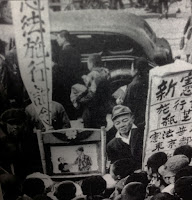
What I recollect about Kamishibai was how it demonstrated its power to communicate when the new Japanese Constitution was promulgated in 1948, using the old medium of popular entertainment to educate. An attentive street crowd was informed about important impending changes. The banner and sign advertised the new constitution coming into effect. The photo attached was taken from the famous book, Embracing Defeat by John Dower. Tokujiro Kanamori (1886-1959), State Minister under Prime Minister Shigeru Yoshida was strongly involved.

The latest World Kamishibai Day initiative promotes the idea that Kamishibai lessons can imprint unforgettable memories in children, invoking the same level of curiosity and enthusiasm from rivaling content on smartphones and tablets.

2

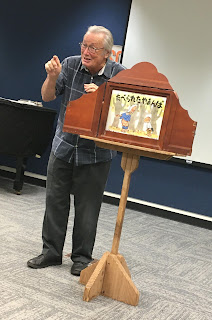
The San Diego Library “Rebellious Miss Breed” retrospective purportedly continues ‘from Sept 2021 to Jan 2022' and its Kamishibai special program was scheduled at the Rancho Bernardo public library on November 19. I asked my friends, the Kaneko family, living nearby, to attend if possible and report back. Kaneko-san attended with her son’s family, including grandchildren aged 8 and 6. To my and their disappointment, no Kamishibai plays related to Miss Breed were performed that day. However, the grandchildren seemed to have enjoyed them all. The following three Kamishibai were performed by Mr. Walter Ritter, the narrator/performer, surrounded by 10 adults and a dozen children that made up the audience.

  1. Taberareta Yamanba, The Mountain Witch that was Eaten
  2. Chinese folk tale
  3. American tale

According to Mr. Ritter, two Kamishibai stories related to Miss Breed are available. I tried looking for a performance date, but could not find any. They are Boy Tetsuzo, about whom I know and talked to person, and Fusa Tsumagari.

3

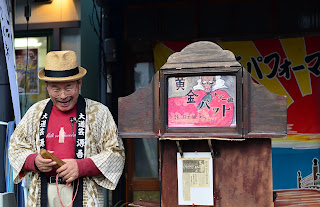
One of the most well-known original stories that was first performed using Kamishibai was Ogon Bat (The Golden Bat), a Japanese superhero created in 1931. The popular character eventually made the transition to manga and anime adaptations.

Sunday, December 5, 2021

4215 Trias

I read the obituary of Miss Clara Breed when I was visiting San Diego as a traveler after retiring from Kyocera. I met Clara several times in the late ‘70s at a fundraising board meeting of the San Diego Balboa Park Friendship Garden project, with the Honorable Japanese Consulate General Will Happen Jr. as President, Clara as secretary (requested perhaps by Joe and Liz Yamada) sitting on the Board, and me, representing my employer - Kyocera.

The obituary opened my eyes to her career as the ex-President of San Diego Public Library, and her close associations with the Japanese community, especially with children during the very dark period when they spent their days in concentration camps during World War II.

I wrote "4215" with my felt-tipped pen, followed by "Trias" on the notebook I carried then and it became my Breed notebook ever since. Trias in Mission Hills, San Diego is located a bit north of Fashion Valley on the slope. The neighboring Hillcrest has UCSD Medical Center Complex on the plateau. I frequented the above mentioned Honorable Japanese Consul General Wil Hippen Jr.’s residence close to Presidio Park for various projects which included the Japanese Naval Force band reception on Ports Call.

Losing husband Ruden, a pastor, Clara’s mother Estella arrived in San Diego in the 1920s, invited by Estella’s sister and her husband. Clara graduated from San Diego High as an honor student. Her school activities were diverse - art, horseback riding, tennis and making graduation albums. She made her own miniature house zoo, feeding foxes, raccoons and possums. I assumed early San Diegans enjoyed a life close to nature.

In the obituary, I read Clara kept a boxful of letters from children and when I called Liz Yamada, she already donated them to the Japanese-American National Library (JANL). She introduced me to Tetsuzo Hirasaki for a meeting and I had a valuable conversation with Tetsu (he passed away shortly after we met).

I visited JANL and copied a few letters from children reading “Dear Miss Breed” as samples. I was told the library was in the process of sorting through them and would take at least six months to finish. Joanne Oppenheim, the author of the Dear Miss Breed (Scholastics), miraculously found out about Miss Breed by inquiring at JANL about her Japanese classmate and started interviewing 'Miss Breed's children'. I heard about Joanne’s interviews through Liz and waited until her book came out in 2006.

The Japanese edition of Joanne Oppenheim's book came out in July 2008. Not bad! The translation took me two years (I wish to thank Eisho-no-Kai members for partial translation) and only had to count days needed to find a publisher. Luckily, Kashiwa Shobo in Tokyo came to my rescue.

I have to thank Teiko Uemura as my great self-sacrificing partner. She helped organize the manuscript into a fine, neatly typed Japanese version. I met her at Kumamoto Toastmasters Club and we bonded over sharing a cordial spirit. She later moved to Hachioji, Tokyo but we remain tied in the same spirit.

Latest Honors bestowed upon Clara Breed:

2014: California Library Hall of Fame by California Library Association

2007: San Diego Women Hall of Fame in the Cultural Bridge Builder category

2006: Smithsonian Institute incorporated four of the Dear Miss Breed letters into lesson plans to be used in Business School documents

Friday, December 25, 2020

People We Lost in 2020: Remembering the Yamadas

I learned about the sudden deaths of Joe and Elizabeth Yamada in May by reading the first digitized "Footprints", the combined Spring-Summer Quarterly issues published by the Japanese American Historical Society of San Diego (JAHSSD). I contacted my San Diego friends who was close to them. After my wife and I left San Diego in the mid 1990’s, our contacts with friends in the US gradually faded. What I learned from my contacts was that Joe had been suffering from Alzheimer’s, Beth was nursing him unsparingly. I understand a very fatigued Beth succumbed a few days later after Joe. I hastened my condolatory donation through JAHSSD.

Around the same time, I was pleased to receive a complimentary children’s book from another San Diego friend Write to Me by Cynthia Grady (New Mexico), illustration by Amiko Hirano (Mass). It is a 30-page booklet, published by Charlesbridge. When my translation of Joanne Oppenheim's Dear Miss Breed was published from Kashiwa Book Publishing Tokyo, I received comments from many Japanese readers to cinematize it. The story was dramatized in San Diego by Andy Lowe in early 2000. However, it never occurred to me to make it a children’s book. It is a great idea to visualize the stories for children. I salute both the producer Cynthia and the illustrator Amiko for a job well done.

I noted Joanne Oppenheim, writer of Dear Miss Breed (Scholastic) sent her memorial writing for Joe and Elizabeth to JAHSSD.

It was about half a century ago when I met Clara Breed, a fill-in secretary at the time, and Joe and Elizabeth Yamada, at the San Diego Balboa Park Japanese Friendship Garden Preparation and Funding Committee Meeting, headed by Will Happen Jr, the Honorable Japanese General Consul in San Diego. I represented my employer in the Committee. However, I did not know the relationship between Clara Breed and the Yamadas. It was after the funeral of Clara Breed that I came to know about their beautiful correspondences during their tense incarcerated camp life. In researching the childrens’ letters myself, I learned Joanne Oppenheim had started interviewing Breed’s children. I waited for her book to be published and translated it for the sake of all the young Japanese children upon returning to Japan.

Saturday, July 13, 2019

San Diego TV Program Features Clara Breed

Hurray to the recent San Diego KGTV special program that featured Asian Pacific American Heritage Month! One of the highlights of the program was about Clara Breed, a San Diego Librarian (1906-1994). Let me applaud Rina Nakano who produced the program, having learned about hundreds of letters (she exquisitely called “letters of hope”) exchanged between the children of Japanese descent in the World War II internment camps and Clara Breed, then serving as the children’s librarian in San Diego. I hope Rina had a chance to visit the Japanese-American National Museum (JANM) in Los Angeles to see the original handwritten letters by the children. I went there myself in 1995, after Breed’s funeral. I had worked together with Clara Breed on the Planning Stage Committee of the Japanese Friendship Garden to be established inside Balboa Park. The committee was presided by Wil Hippen, Jr., Honorary Consul General of Japan. I represented my Japanese employer, and Clara was the voluntary substitute secretary of the committee. This was arranged by Liz Yamada, who sat on the committee along with Joe Yamada, her husband. I didn’t really know who Clara was at the time. I did notice that the minutes she wrote were superb and I voiced my appreciation.

I contacted Liz Yamada after reading Clara’s obituary, having learned about how a box full of children’s letters addressed to her have been donated to JANM. I immediately visited JANM and found the letters in the process of being scanned. I was able to copy some of them in the hope of writing about Clara Breed. I also contacted the Japanese-American Historical Society of San Diego (JAHSSD). Joyce League, then editor of JAHSSD “Footprint”, told me about a New York writer named Joanne Oppenheim who had started interviewing their members for a book. She advised me to wait for her book to be published.

To make a long story short, I read Joanne’s book, titled Dear Miss Breed, when it first came out and felt it my mission to translate it into Japanese. I wanted as many young Japanese children as possible to know that there was an American woman who gave “letters of immense help” and hope to the children who found themselves under adverse circumstances.

My translation had a print run of 6,000 copies in 2007 and I’m glad they reached all major metropolitan city libraries as well as libraries of major educational institutions in Japan.

Tuesday, July 28, 2015

Infamy

My son, who lives in New York, took the trouble to airfreight me Richard Reeves’ Infamy, a 340 page book newly published by Henry Holt & Co. The subtitle reads “The Shocking Story of the Japanese American Internment in World War II.” This is the first book Joanne Oppenheim’s Dear Miss Breed is quoted extensively. I was happy to find Clara Breed’s photo in the book. She was the children’s librarian at the San Diego Public Library, who met hundreds of young Japanese-Americans and during the internment years, she sent them letters, books, and gifts. I saw names and letters of many 'Breed’s children' - Louise Ogawa, Katherine Tasaki, Margaret Ishino, Fusa and Yukio Tsumagari, Ted Hirasaki, Hisako Watanabe. Now all these names will be remembered as unjustly incarcerated internees who endured and lived with grace despite the harsh circumstances during a sad period in American history.

I myself befriended Clara Breed when she served as volunteer secretary for the San Diego Japanese Friendship Garden Planning Board (SDJFPB) without knowing her background at all. I was so shocked to see her obituary and found out who she was upon my return to Japan.

Sitting with me at the SDJFPB were Joe and Elizabeth Yamada, members of the 'Breed children' whom I contacted asking about some of the children’s letters that were sent to and saved by Clara Breed from Poston, Arizona. As per Elizabeth Yamada, they had been entrusted with the Japanese American National Museum (JANM) in Los Angeles. I visited JANM from Japan and copied some handwritten letters. Elizabeth Yamada then introduced me to Ted Hirasaki and Ben Segawa in San Diego. At JANM, I met Babe Karasawa who was serving as a volunteer docent. Soon I heard from my San Diego friends that Joanne Oppenheim had started interviewing the 'Breed children' with the intent of writing a book, suggesting that I wait for her book.

Oppenheim's book was well worth waiting for and inspired me to translate it into Japanese. One of my motivations for the translation was to make Japanese children aware of historical events. Oppenheim added court testimonies so that voices of internists from cities other than San Diego could be included. She toiled to try to cover over 10 relocation camps by quoting 1) Mrs. Roosevelt's diaries and 2) nationwide court testimonies. I’m glad that today, most of the Japanese municipal libraries and junior and senior high school libraries carry my Dear Miss Breed translation as I so aimed.

As a professional historian, Richard Reeves documented numerous narrative stories from ten relocation centers, making this book a very comprehensive compilation to date for all camp sites in seven States – California, Idaho, Utah, Wyoming, Arizona, Colorado and Arkansas.

The following two stories from Infamy were particularly memorable to me.

The 1942 valedictorian of the University of California, Berkeley, Harvey Itano, was in the Sacramento Assembly Center on his graduation day. "Harvey cannot be with us today," said university president Robert Gordon Sproul. He continued, "His country has called him elsewhere," which was behind barbed wire (Page 81). I became acquainted with Dr. Itano, a La Jolla resident, with whom I played golf often. He was a great golfer.

By mid-summer Isamu Noguchi realized he was having a lot of trouble adjusting to life in the camp. He set up an Arts and Handcraft Center in Poston but no one came. He had a lot of trouble communicating with his fellow residents. "I am extremely despondent for lack of companionship," he wrote to John Collier in Washington, "The Nisei here are not of my own age and are of an entirely different background and interest." Noguchi's name is mentioned in Dear Miss Breed. Noguchi left Poston when the army allowed him leave. Isamu Noguchi was in Poston for 184 days. He wrote to his half sister Ailes "Please let my friends know that I am on my way. I feel like Rip Van Winkle" (Page 129).

Notes:
As the author wrote, the Japanese Americans in Hawaii were mostly exempt from being sent to internment camps except hundreds of them were closely watched by the FBI. Sand Island, a 5-acre island of coral in Honolulu, used to quarantine ships believed to carry contagious passengers in the nineteenth century, served as a location for a camp but the detainees were later sent to the 160-acre Honouliuli Camp in Oahu to join other German, Italian and Korean detainees. The Honouliuli Camp was designated earlier this year by President Obama as a National Park. It seems that each island had similar facilities of its own. The Big Island camp was at the Kilauea Military Camp (KMC), which was located in the volcano area, according to my friend Ron Takata who lives there.

Wednesday, September 25, 2013

Revisiting Balboa Park Japanese Friendship Garden

I wish to dedicate this article to: Will Hippen, Jr., Clara Breed, Marge Wells, Mark Umemura, Ken Takada, Denny Ikeda, and George Woodworth.

Recently, I had the chance to re-visit the Balboa Park Japanese Friendship Garden. I tried to rely on my memory to find the entrance from the Organ Pavilion, the center of San Diego Balboa Park. I found myself at the VIP (or service) gate which was locked to the general public. Once I realized I was at the wrong gate, I stopped two girls who seemed to be returning from lunch and told them that I had an appointment with the Japanese Friendship Garden Executives. They opened the gate and ushered me into the nearest building, which was their administrative building, and fortunately exactly where I was supposed to be.

I found about five people there, one young man and four young women. From their appearances I guessed they were sales people selling wedding banquets. The waiting room table was full with wedding service advertisements for photographers, florists, hairdressers, and the like. When I was walking out around 4:30 p.m., a banquet setting was in preparation. I saw outdoor lighting, catering gear, band crew instruments, and other things that suggested a wedding. Seemingly the main business associated with the garden is related to wedding banquets. These young people were very lively, and I am sure they were quite good at selling the banquets. The Japanese Garden has a long history of catering to weddings; the brochure said 15 years of service.

The conceptual starting date, however, could go back at least 25 years ago. Will Hippen, Jr., Honorary Consul General of Japan in San Diego, 1st President and donor himself of the Japanese Friendship Garden, raised the banner and blazed the trail. He had his own Japanese garden complete with Koi pond and tea house, where he held a reception party more than once when the Japanese self-defense Navy frigate visited San Diego port. He invited officers and sailors alike, members of SD-Yokohama sister-city relations to mingle with food and drink, while the Japanese naval band played both US and Japanese music.

Two ideas for a Japanese Garden were circulating. The first had to do with the city of San Diego contemplating if its Balboa Park gorge area could be developed into a Japanese garden. The second consisted of a local group of Japanese Americans trying to rebuild the Japanese garden, a popular 1915 Panama International Exhibit, which was destroyed during WWII. It was Will Hippen who combined these two ideas into one grand plan. He first asked Mayor Wilson, and then his successor Rodger Hedgecock to sign a 100-year lease agreement to use the gorge in Balboa Park as a Japanese Friendship Garden. Thankfully, he ultimately succeeded. I was honored to attend the signing ceremony at the Mayor’s office.

A fund raising campaign started immediately with a very tough requirement; the lease agreement stipulated there be enough money to break ground on the project by a specified date. My former company, Kyocera, took the lead in the campaign, as Dr. Inamori, President, was thankful and enthusiastic for being listed among the best San Diego businesses to participate in the project. The Japanese Friendship Garden concept struck his heart and his first comment upon visiting Balboa Park was “Kyoto where he resides has more challenging venues than Balboa gorge and he never worried about the awkward cliff and sharp slopes to landscape despite the misgivings of the local people.”

When I left San Diego in the mid-1990s, I remembered the Japanese Friendship Garden sitting only on top of the gorge close to the Organ Pavilion, the Meiji style gate designed by Storrier Sterns, the curved pathways along the bamboo groves, the exhibit house as the main event center, the Karesansui (dried garden), the outdoor tea reception stage, etc. The crepe myrtle I donated in memory of Denny Ikeda (a Kyocera employee gunned down by two ruffians near Sea World) was still there, extending its branches.

Today, going down through Stern’s gate (which was moved to the newly expanded garden), I was thrilled to see a couple of pseudo-glens already covered with white stones—one cascade to be covered in water, other perhaps to remain dry—as I strolled down the cherry tree pathway. Mike Kawamura, the Japanese Friendship Garden VP and my fellow colleague at work, told me that more than 100 cherry trees were transplanted already. Honestly, I felt uneasy as to whether my physical stamina could carry me down the gorge and back to the top. Thanks to the ADA compliant strolling pathway, I had no problem, but found myself exhilarated with the walk while viewing the camellia/azalea slope garden.

As per their latest new release, the Japanese Friendship Garden, just a month ago, had the August Moon Gala and Awards Dinner celebration to open its north end of the garden expansion before the official public opening. This addition is now open. I saw many people walking down the roughly planted gorge, crossing the Dragon Bridge, zigzagging the cherry tree grove, stopping at one of the pairing ponds.

The other pairing pond, larger than the pond near the Dragon Bridge, is coming with what the Japanese Friendship Garden is calling the “Pavilion” and “Amphitheater”; the next and perhaps the last phase of construction. It will be located where the horse stables of the SD Park Police were once found. I heard that the Pavilion could be PAGODA shaped. That’s a fantastic concept and could contribute to this garden becoming the best West Coast Japanese garden; perhaps rivaling the Sankei-en gardens in Yokohama, Japan, which acclaimed the world’s best by Tagor and others. Dennis Otsuji is confident. The Japanese Friendship Garden President said they could definitely finish all the construction by 2015, the year SD will celebrate the 100th anniversary of its Panama Exhibition at Balboa Park.

Finally, I dropped in at the donors’ board and fondly found very familiar names: fellow Japanese corporations: Sanyo, Sony, Fujitsu, Nissan, Union Bank. San Diego corporations: Naiman, A.O. Reed, Qualcom, Kokusai Travel. Then, Acquaintances: Saburo Muraoka & Family, Bruce Henderson, Marge Wells, Moto Asakawa & Family, Kay Leonard/J. Forsyth, Dr. R. Phillips, Dr. Harvey Itano, Takeo Uesugi, Kuramoto, Bishop, Bogart, Arthur Jonishi, 5 Samurais of Kyocera.

Links:

Japanese Friendship Garden of San Diego

Discover Nikkei article source
Tuesday, January 18, 2011

The Changing Nature of Dear Miss Breed’s Popularity

Three years after its publication, there has been a definite change in how the Japanese translation of Dear Miss Breed is being received by the public. The translation was published by Kashiwa Shobo in mid-2008. During the first year, I remember, reviewers were all syndicated professionals. They mostly gave very favorable comments which seemed to trigger a chain reaction of similar reviews. Mr. Seinosuke Nakashima, an art historian and essayist, highly recommended the book for young people, which I very much appreciated. I also received a personal thank-you from a reader for my translation effort.

Dear Miss Breed, the original English book by Joanne Oppenheim may have been first introduced to the Japanese in 2007 in an article written by Dr. Keiichi Ogawa for the Kanagawa Newspaper prior to the release of my translation. Dr. Ogawa, a Yokohama City Library Headmaster, visited San Diego City Library in early 2007. (San Diego is the sister city of Yokohama.) His visit happened to coincide with Clara Breed’s 100th birthday and was presented with Joanne’s book. He raced through the book on his return flight to Japan and was very impressed. He submitted his book review to a local newspaper. I was working hard on the translation at the time not knowing about Dr. Ogawa’s review. Unintentionally, I did a search on Dear Miss Breed online and found a fervent plea from one of the readers of the Kanagawa paper who commented,“Can someone please translate the book for me?” I was surprised and intrigued. I contacted Dr. Ogawa to inquire about the background of his introduction while speeding up the translation process. I got a personal thank-you from that young reader in Kanagawa when the translation was finally published.

The new trends I mentioned at the outset are l) the book is now being read by young children and 2) Miss Breed has become a role model for librarians.

l) I'm happy to see my translation being classified as a “non-fiction picture book." A monthly magazine called "Bookshelves for Children" and a research firm, "Books for Japanese Children," both named Dear Miss Breed as their top selection. My original intent was to target children even though I received many comments that the subject matter may be a little too harsh for children.

2) Librarians from major cities including Yokohama, Shizuoka, Fukuoka and others created a traveling "Tamashii Juku" or "Tamashii School" training Symposium. The first symposium was held in Shizuoka and I heard they used "Clara Breed" as a role model and used my translation as the textbook. I heard many public libraries are equally enthused and are following the lead of Yokohama and Shizuoka librarians. A book called Librarian, the Sorceress was published recently.

Thursday, March 26, 2009

Famous Art Historian Recommends Dear Miss Breed

Art historian / essayist Seinosuke Nakajima reviewed the book Dear Miss Breed (written by Joanne Oppenheim, translated by Rio Imamura, published by Kashiwashobo) for the January 31, 2009 Book Review Club column of the Sankei Newspaper of Tokyo. Below is my translation of the article.

*****

The story begins with the discovery of letters and mementos bequeathed by Clara Breed, a librarian hired in charge of children by the City Library of San Diego. There were over 200 letters eventually donated to the National Museum of Japanese Americans in Los Angeles, including one-cent postcards and envelopes with three-cents V (for victory) stamps.

There was a letter written by 6-year old Florence Ishino in tottering alphabet or another written by 17-year old Louise Ogawa in a refined, elegant style. They were living proof of sad and unfortunate injustices, a part of American history, almost buried and out of sight for half a century. It is bygone history, yet still remembered.

When World War II broke out with the Pearl Harbor attack by the Imperial Japanese army, the Japanese American mothers living in California immediately organized Red Cross activities, blood drives, bandage service, war bond drives, etc. in their effort to alleviate their shame, infamies and awkwardness. Clara Breed comforted them saying this is America where everyone is treated equally with no bias.

Things did not turn out as she predicted. Suspicions and hatred prevailed. Japanese Americans were treated no different from the despicable enemy “Japs”. Everyone who had Japanese ancestry was sent the President Executive Order to go to internment camps, away from their homes in California. That number reached 120,000 in total.

The day before the evacuation, Clara distributed self-addressed cards hurriedly printed with one-cent stamps on them to children she knew and asked them “be sure to write back.” She told them, “I will send you books.”

The book Dear Miss Breed, along with the children's letters, shows rare photos taken inside internment camps by cameras that were officially forbidden. Also shown were harsh hate illustrations and cartoons such as “Jap” hunting licenses, deformed buck teeth and slanted-eye caricatures of Japanese. These images contrasted sharply with images of smiling children, despite their adversity, acting brave and bright and young men working hard in farms and camps.

What struck us most is the touching humanity and boundless love of a woman named Clara and the young Japanese Americans who heroically walked their life believing in their futures.

The testimony of Grace Nakamura deftly expressed the feeling: “Until you lose your freedom, you do not realize how dear it is. There is no price tag for freedom.”

*****

Seinosuke Nakajima was born in 1938 and is known as the Godfather of the Aoyama curio shop street in Tokyo. He authored “50 years as Pottery Critic”.

Sunday, August 3, 2008

Part III: Translating Dear Miss Breed

I visited the Museum again in 2004 and the Miss Breed Corner was established with a large photo. I was told that the Joanne Oppenheim had started interviewing Breed's children. I decided to wait for Oppenheim's book to be published. I saw her book two years later and found it truly inspirational.

I was determined to translate Joanne Oppenheim's Dear Miss Breed into Japanese for the young Japanese readers so that they could learn about what transpired. I look forward to the day when the Japanese boys and girls acquire enough English language skills so they can fully appreciate the author's original text.

I wanted them to know when they are as young as Miss Breed's "children" were, that there was a remarkable librarian named Miss Breed who loved the young disciplined Japanese Americans and gave them strength and inspiration by tirelessly sending them books. These interned children were confined and isolated, sent away to remote concentration camps. A collection of letters written by Miss Breed's "children" would surely strike the hearts of the Japanese young readers.

I expressed my wish to be a translator both to the author and publisher as soon as Dear Miss Breed was published in April 2006. The publisher replied in June and stated that I had to go through a Japanese book underwriter/publisher. I had a number of such publishing houses in mind but I realized that they would immediately ask for a manuscript, which I didn't have. I know translation without any publisher endorsement was risky, but I felt such a strong commitment to do it anyway. There's a Japanese saying "Knowing what is right without participating in it betrays one's cowardice." I knew that there was a risk of not obtaining translation rights.

In early 2007, Dr. Keiichi Ogawa (ex-President of Yokohama City University), paid his courtesy visit to the San Diego City Library, representing Yokohama City Library, since San Diego and Yokohama are sister cities. He happened to witness the 100th birthday celebration of Clara Breed, the Head Librarian, and he was presented Joanne Oppenheim's book by Anna Tatar, the current Library Director. He read the book upon his return to Japan and he introduced "Miss Breed" in the local Kanagawa newspaper. The paper stirred a lot of interest and many expressed ardent wishes to read it in Japanese. I was about half way finished with the translation when I found out about this interest. I redoubled my efforts with the help of compassionate friends like Mrs. Teiko Uemura (ex-Kumamoto Toastmaster, now Hachioji Toastmaster) and Mrs. Shida's group in Hino, Tokyo which was my home before I moved to Kitakyushu.

I had finished two-thirds of the book in August 2007. I sent the first third of the translated manuscript out in May / June 2007 as a sample to find a publisher. I sent it to several publishers without much luck. Then I saw a translation of Michael Moore's book published by Kashiwa. Encouraged, I sent Kashiwa a copy and they showed interest. By October, the full translation was completed and submitted. The first proofs arrived April. The next three months were spent mostly finishing the bibliography, indexing, more proofreading, translating Joanne's preface to the Japanese readers, ...etc. The book was finally released on June 25, 2008.


The publisher presented the translated book to Dr. Keiichi Ogawa, Director of Yokohama Central City Library.

His comments were:

"I am so pleased to see the accurate and faithful Japanese translation by Rio Imamura. I am refreshing the moment and my memory when I encountered the book two years ago. The book touched my heart. It was so moving and inspiring. Thank you for referring to my introduction of the book in the the local Kanagawa Newspaper. I am hoping that the younger generations will read the book from two perspectives. One is the absurdity of war, and the other is humanity, love for mankind. I hope this book will be read by many people. My hearty congratulations on the completion! Very well done!"

*****

I wish to share the pleasure of getting the translated book published with my friends. I thought translating/publishing it into Japanese would be my way of thanking the Japanese American community for sharing the above Garden project, and for their support and cooperation in building and managing Minato Gakuen, the Saturday School for the Japanese expatriate children in the Sweetwater District. I have enjoyed the privilege of befriending many people in San Diego - Ben Sagawa, Liz and Joe Yamada, Saburo Muraoka, Moto Asakawa, Jack Hamaguchi, Don Estes, and Joyce and Bill Teague. It has been very rewarding and an honor to be involved in Clara Breed's legacy.

Saturday, August 2, 2008

Part II: Clara Breed's "Children" and Letters

In l994, the year of my retirement, I returned to Japan with my wife, respecting my wife's preference to live in Japan. Our children and their families live in the U.S., so we have made it a point to visit the U.S. every year. On one such trip, I came across Clara Breed's obituary in the paper and discovered who she was (besides being a wonderful stenographer) and what she did during the war - her constant commitment to the Japanese American children during their internment through letters which she kept. Clara worked for the San Diego Library her entire life. She became Chief Librarian and at retirement was honored with various awards from the city. To my great surprise, the paper reported that many Japanese Americans attended her funeral service.

The story of Clara Breed and her students dates back to 1941, the attack on Pearl Harbor by the Japanese, and the beginning of World War II. Clara had met many Japanese American children at the library. She was in charge of handling books at the time. She noted that these Japanese Americans were diligent children with good manners. She liked them very much.

When these children were sent to the concentration camps, she asked them to write to her and she would send them books. The children thanked her for the books, adding notes about their lives in the camp and their hardships, problems, and anxieties about their future. Their letters were rather like an American version of the Diary of Anne Frank.

Clara answered every letter she received and tried to coordinate between the libraries close to the camp sites. She wrote to the State Department to reconsider the treatment of Japanese Americans in the camps. She tried hard to get visitation to the camp site to see "her" children. She was a person with an iron will who turned her ideas into action!

It occurred to me one of Clara's children was most likely among the Officers of the Japanese Friendship Garden. It turned out that Liz Yamada, who was eight years old when World War II broke out, and her sister corresponded with Clara. Liz's family lived in the Santa Ana Horse Racing stables until they were relocated to Poston, Arizona. I called Liz Yamada to ask her about these letters and Liz said she had donated all of them to the Japanese American National Museum in Los Angeles.

I also met Tetsuzo "Ted" Hirasaki, who was close to Clara through Liz. Ted, the eldest boy among the interned children, was 16 years old at the start of the War. Ted enlisted with the Nisei Troops directly from camp. Despite the bitter experience of internment, almost all Japanese living in America expressed a strong desire to prove their loyalty. Many Nisei - children born in the U.S. of Japanese parentage - enlisted in the armed forces, such as the infantry of the much decorated 442nd Regimental Combat Team. In all, 8,000 Japanese joined the armed forces despite the loss of their civil liberties at home. The 442nd Combat Team received many citations for bravery in l944.

I visited Ted at his home right away. Ted was working at General Dynamics. He was a man of knowledge and quite a speaker. He had an extensive vocabulary. He was saddened at Clara's death. He said he owed her a great debt of gratitude for the many things she did and wanted to preserve her legacy. Ted and others helped collect and organize the Clara Breed letters and sent them to the Japanese American National Museum in Los Angeles.

In the summer of 2002, I visited the newly built Japanese American National Museum in Little Tokyo located in downtown Los Angeles. I found Clara's photo in the Who' s Who information, together with sample of letters to Clara from the children in the camps. Visitors have access to typewritten letter files upon request. It probably took me more than an hour to review them all. It was a pretty thick file. I would like to share am excerpt.

"Dear Miss Breed,
Thank you for sending William Saroyan's Human Comedy. I'm glad you liked the doll I handmade for you......Two things I can't take in Poston. The sand storms and the heat! Many people here have rashes to treat....The other night I had a dream. I had permission to go back to San Diego. The moment I gout out at the station, I was in a candy store... You are standing behind me. I bought 5 pounds of chocolate... and U was asking you... Would it melt before I could go back to my house?"

The letters were in the process of being sorted and digitized. The librarian assured me that by my next return visit, I should see them online. It was probably around this time that Joanne Oppenheim found the letters and decided to write a book.

Friday, August 1, 2008

Part I: Meeting Clara Breed

I wrote in the translator's notes of the Japanese edition of Dear Miss Breed, that one of my motivations in working on this book was based on the fact that Clara Breed and I worked together one time on the Japanese Garden Project in Balboa Park in the 1980s.

A Japanese Tea Pavilion with garden was built in l915 for the Pan American California Exposition in Balboa Park. It was later demolished when the San Diego Zoo was constructed. The City of San Diego had promised 10 acres (about 4 hectares) inside Balboa Park to recreate it. Will Hippen, the San Diego-Yokohama Sister City Society and the Honorary Consul General, led the formation of the nonprofit organization called Japan-U.S. Friendship Garden Society, with the slogan "Rebuild the Garden". Corporate donors were recruited including companies such as Kyocera, Sony, Union Bank of California. Many local Japanese American citizens such as Joe and Elizabeth Yamada, Roy Muraoka, Moto Asakawa and others got involved as well. Sounds so easy and simple now but it was a tough job, beginning with fund raising campaigns and detailed plans which took decades to finalize. It was a huge project. More than 20 years have elapsed since it's completion. I can proudly say that San Diego now has one of the best Japanese gardens that can compete with any of the west coast Japanese gardens.

I came to know Clara Breed from the board meetings of Officers of the U.S.-Japan Friendship Garden Society. At that time I was on the Board of Directors along with Joe and Elizabeth Yamada. Clara had been called in occasionally to substitute as Secretary when the regular Secretary was unable to attend. Perhaps she was called in by Liz Yamada, who I later learned was one of the Breed children Clara had inspired and shared affection with during the Japanese American internment camp days of World War II. Clara was a graceful woman. I commended her on the quality of minutes she produced, all taken in shorthand. She smiled and thanked me.