Tuesday, September 28, 2010

Millennium Subway

A subway is much easier to ride than a bus when foreigners try to scramble around an unfamiliar country. Taipei became friendlier to me when its MRT System opened in the late 1990s. I could go north or south, east or west as I pleased without any help from local friends. I look forward to doing the same in Kaohsiung on my next visit as a new KMRT System opened in late 2008. I happened to be in Montreal and was honored with a free ride when it opened its French rubber tire metro system in 1966.

I was excited when Edit, my Hungarian friend, told me that Budapest has one of the oldest subway systems in the world - the Millennium Subway. The decision to have a subway was made when three cities, Buda, Obuda and Pest merged into one in 1873 in commemoration of the 1,000th anniversary of Magyarok by Emperor Franz Joseph. It seemed Budapest was then competing with its rival city Vienna. Coincidentally, cities like London, New York and Chicago were all planning underground railways, but using steam locomotives. The change from locomotives to electric vehicles came after 1900, London in 1902, and New York 1904 (Interborough Rapid Transit – 9th Ave line).

For Hungarian metro, two local firms and German Siemens & Halske AG worked together to build the line entirely from the surface using a cut and cover method. Called Franz Joseph Line, the length of line is 3.68 kilometers of which 3.22 kiloneters ran underground. The service started on May 2, 1896. Therefore this line subway is petty shallow, just about 5 meters deep. You can jump into a car in under 10 seconds if you so desire.

Today, the subway system has 3 lines totaling 32 kilometers, color coded in yellow (Millennium line), blue (opened 1976, north to south), red (opened in 1970, east to west) and one line under construction scheduled to open in 2012. Daily users total 1.3 million people.

In 2002, this Millennium line, along with the Andrassy ut running on top of the subway got the World Heritage designation. Andrassy ut is an iconic boulevard, compared with Paris’ Chanselise, linked with notable spots like Opera House, the House of Terror, Memorial Houses of Franz Liszt and Lolton Kadraly, Heroe’s and Elizabeth Squares.

There's a subway museum you can visit near the Deak Frerenc Station where you can view some of the original cars.

Friday, September 24, 2010

"It's not only enough to be Hungarian. One must also have talent"

The name Bartok struck me when I was listening to the music tape sent from my New York friend. I loved his Violin Concertos which are unique and different and wondered where he was born. He was a Hungarian, although he immigrated to the U.S.

I saw photographs of Robert Capa. His real name was Friedmann, a Hungarian. Then one day I saw Andrew Grove, President of Intel in San Diego. I read his memoir Swimming Across and found he was Grof Andras Istvan, a Hungarian. Upon returning to Japan, I had a chance to listen to Peter Frankl, a genius mathematician and a professional road juggler, a Hungarian now residing in Japan. He wrote many books in Japanese, including his autobiography Why I speak 11 languages.

Over a dozen Hungarian scientists are listed as Nobel Laureates, including Eugene Wigner, who was involved in the Manhattan Project; Rubik Erno, who established the International Rubik Foundation; George Soros, CEO of Soros Fund Management; Biro Laszlo, an inventor of ball point pens; and Neumann Janos, mathematician / physicist best known for his game theory. In 2002, Imre Kertesz joined as the first Hungarian writer to win the Nobel prize for literature. He wrote his semi-autobiographical novel Fateless dealing with the Holocaust.

According to Peter Frankl, who serves on the Hungarian Academy of Science as an adviser, research conducted on the Hungarian genes did not reveal any uniqueness compared to neighboring nationalities of Serbians, Romanians, ...,etc. Hence the teaching "not only to be Hungarian, he has to have a talent." The same applies to the Japanese as well, all the more.

I had a friend in Budapest, who studied Japanese in Kitakyushu. Her Japanese is excellent. To speak Japanese that fluently, one would have had to spend at least a couple of years in Japan. Her English is also superb, as she had studied in Australia. During my trip there, her boyfriend, who was also a friend of mine, visited Budapest from Mexico. We got together for a little reunion. What a combination between Hungarian and Mexican! They met in Kitakyushu. She was applying for a job with a Japanese manufacturer and she was told her interview went well. In a cafe, we toasted to her success.

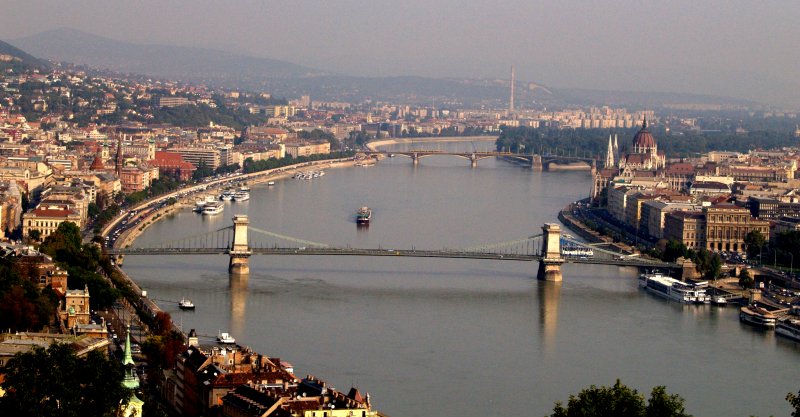
I stayed in a Buda side hotel, by the Deli Station for 5 days because of its proximity to the Gellert and Castle Hills and the hotel where the Hungarian Toastmasters met. I moved to the Pest side hotel one day before leaving for Vienna from Keleti Station. I took a day trip by train to rustic Szentendre on the Danube Bend, and a boat ride coming back. It was a wonderful sunny afternoon to view the Chain Bridge and the Royal Palace. The waltz "Blue Danube" was written by Johann Strauss for his Hungarian friend / writer Carl Beck.

Saturday, September 18, 2010

Regina Lantern Fest

It was a strange parade!

Halloween? No, a little too early. Chinese Dragon Festival? No. No snake dragons and no drums. Japanese Bon Festival? No. No dancing and no drums.

The twilight veil crept in over the Wascana Lake in Regina, Saskatchewan one summer night in 2001. Autos arrived and unloaded people from everywhere. They flocked together along the lake and divided into two groups. The first group carried lanterns and formed a line. The second group joined the onlookers, away from the formed lines.

Verna, my Regina friend, her two children, and I waited for her husband, Ramon, who went to park the car. We waited under the well-lit park lights. The children needed to use the porta-potties, which were neatly set up along the edge of the park. Ramon soon joined us and we sat on the shore rocks, along with the other onlookers. This man-made lake has white sands on the beach.

The parade started moving as darkness fell. No music. No announcement. Silent, slow, but a steady parade. It moved clockwise along the lake. Lanterns waved between the trees. Across the lake, two boats sailed counterclockwise with three lanterns hung on each side of the boats as they circled the lake. As they sailed in front of us, I recognized that they were the dragon boats that I had seen the other day on the lake. Rowers paddled in silhouette without sounds.

The parade came to a stop when it made a half circle of the lake. The onlookers dispersed in twos and threes. Everyone remained silent.

What kind of parade is this? I went to the library before leaving Regina. After searching for half an hour, I found a microfilmed local paper dated May 2000. "Based on the success of last year's Lanterns on the Lake, we expect about 10,000 people to show up, enjoy the cool summer night and kick off the Art Festival in the fall. Kits of star-shaped lanterns are on sale for $5.00 each

Note:
Regina has more parks and greenspace per capita than any major city in Canada. Wascana Centre is a huge 9.3 square kilometre (2300 acre) park that is built around the shores of Wascana Lake, a man made lake in the heart of Regina. It is one of North America's largest urban parks, and has several attractions such as several walking and bicycle paths, the Saskatchewan Science Centre, an outdoor pool, a marina with boat rentals, the Saskatchewan Legislative building, and the Saskatchewan Centre of the Arts.

Sunday, August 22, 2010

Visit to Curitiba Part II

In the 2006 book titled Revolutionary Wealth written by the futurists/writers Alvin & Heidi Toffler, there is a passage about a street in Curitiba.

“One midnight we accompanied its former mayor, Jaime Lerner, an urban planner by training, on a visit to its ‘24 Hour Street’, a block glistening with new coffee shops and restaurants jammed with young couples who smile, wave and call out ‘Jaime!’ The next street was designed to house twenty-four-hour professional services – doctors, dentists and lawyers. The next one was planned to hold twenty-four-municipal offices where individuals can get permits or licenses and take care of other city business at any hour.”

I was sorry that I didn’t visit the area described on my 2001 Curitiba trip and only saw the photographs. I read that the ex-mayor got the hint for the 24 Hour Street when he visited Sannomiya, Kobe. I recently asked my Facebook friend in Curitiba how is the street now and the answer was not something I expected. Currently the street is closed until further notice. It seems the plan highly acclaimed as futuristic by Tofflers encountered some glitches. However, my friend emphasized that Curitiba was the first Brazilian city where trucks started picking up house garbage for recycling at least twice a week. I read in a book the initial incentive used by the city was aimed at students. In exchange for bringing in house recyclables, they were offered either stationary or lunch coupons. When the roads were open only for pedestrian traffic, shop owners were against the city ordinance. When business picked up from foot traffic, they hailed the ordinance.

According to history, Jaime Lerner, a Curitiba native and student civil engineer, won the city master plan contest in 1964, in which he was deeply involved. Upon his graduation, he lead the Instituto de Pesquisa e Planejamento Urbano de Curitiba (IPPUC), the official organization to promote city master plans, including zoning, traffic controls, road management, public services,…, etc. Lerner served as Mayor for three terms before being elected to State Governor of Parana. Lerner was succeeded by a number of Japanese Nisei Brazilians who served as mayor, as well as IPPUC director, like Lerner, including Cassio Taniguchi. Their continuous and cumulative endeavors for the past 40 years made Curitiba a vanguard of modern city urbanization.

Lerner was honored as a keynote speaker at the world’s architect UIA Conference in Chicago in 1992. What made the mayor/governor and his followers achieve so much success? I believe their fresh foresight, relentless entrepreneurship and follow-through as a team were the reasons and I salute them.

While in Curitba, I visited, as a plant lover, most of the urban and suburban parks, Jardim Botanico (Botanical Garden, 240 square kilometers), Opera de Arame (Wire Opera House built on two former quarries, 235 square kilometers), Parque Tangua, Bosque Alemano, the German woods and Parque Tingui, the Ukranian Immigration memorial and of course, Praca do Japao. This is why I missed visiting the 24 hour street downtown.

Saturday, August 21, 2010

Visit to Curitiba Part I

Olha
que
coisa
mas
linda

Mais
cheira
de
graca

So goes my favorite song, “Garota de Ipanema”. It’s a whisper to a passing girl by a shy and naïve garoto on the beach. The Bossa Nova born in Rio de Janeiro set New York on fire in the ‘60s until the Beatles took over later. I arrived in NY in 1961, one year after the Brazilian capital moved from Rio to Brazilia.

After 50 years of geopolitical power deprivation, Rio de Janeiro was crowned to host the world’s lst Olympiad del Sur. In 2016, thousands of Olympic visitors and athletes will invade breathtaking Rio of much urban diversity, with beaches, mountains, skyscrapers, and the omnipresent favelas all woven into the fabric of dream landscapes. Most likely everyone will not fail to trek and see the splendor of Iguacu Falls in Parana. What wonderful news!

I missed seeing Rio de Janeiro following a friend's advice to skip it on my solo trip in 2001. I had no intention to visit the favelas, but was warned nevertheless that they are outside the control of the police and neither tour company nor the city police can guarantee safety when entering favelas. It was a hard choice not to include Rio on my itinerary. Thus the last travel week after Buenos Aires and Iguacu was split into Sao Paulo and Curitiba equally. Curitiba was highly recommended by the same friend who had spent years in Sao Paulo.

Curitiba, "Pine Nut Land", however, was a happy surprise, thanks to the excellent advice from my friend. I was awarded with the winning choice. Kitakyushu, the city where I live, and Curitiba, have one thing in common. Both cities were recognized for the “UN Local Government Honors” in the “Earth Summit”, of the UN Conference on Environment & Development held in RJ in 1992. Yes, remember that? That's the Summit where a Canadian Japanese teenager Severn Suzuki delivered a legendary speech that embarrassed all grownups.

Kitakyushu had spearheaded and succeeded in regaining the beauty of water and set to help Asian nations with its anti-pollution control technology through training and exchange of engineers. Curitiba enjoyed international recognition for its excellent urban planning, now followed by cities like Bogota, Seoul, Portland, San Jose, Obihiro and others. I’ll write about my Curitiba visit next time.

Monday, August 16, 2010

Taste of Summer

Banana Yoshimoto coined the phrase, “watermelon, the synonym of summer as the summer without watermelon is improbable” in her novel Thrush. Many are the number of Haikus I found which dealt with watermelons. Listed below are five of my translations, randomly picked.

"Summer lassitude! Bananas and watermelons are so tasty"

"Tapped and patted watermelon head that replied with ok sounds "

"'Monopoly', the fridge complaining of space occupied by watermelon"

"Watermelon “split”! Strange my arms and limbs benumbed and frozen"

"Watermelon “split” is a summer feat with shouts of joys and chuckles"

Yes, watermelon is the king of summer fruits, though some people might object that it is a veggie and not a fruit. No other fruit is like the subtly crunchy, throat quenching watermelon. It is originally from southern Africa. In Egypt, the cultivation was as early as the 2nd millennium BC, as evidenced by wall paintings and the discovery of numerous watermelon seeds recovered from the tomb of Pharaoh Tutankhamun. Greeks and Romans had it 2000 years ago. In the 11th century, it went to China through Turkey and the Silk Road. Moorish invaders introduced it to Europe. In the 17th century, European immigrants carried it to North America.

Here are a few assumptions about watermelon in Japan:
1) Watermelon seeds were found in the prehistoric Yayoi remains in the Okayama area.
2) Chinese Rev. Yinyuan (1592-1673) brought it from China.
3) In 1579, the Portuguese brought it to Nagasaki, together with pumpkins.

Is watermelon good for health? “What an insult!,” a watermelon would protest if it could speak. A Japanese agronomist, Yasusada Miyazaki (1623-1697), who served the Fukuoka Clan, wrote almost 300 years ago in his Compendium of Agriculture that the watermelon not only can beat the summer heat and curb thirst but cures various kinds of illness, including diabetes, and high blood pressure.

Let me list the virtues, in view of the calories, vitamins, antioxidants, diuretic features of watermelons.

1. Slows down aging
2. Prevents heart attack and stroke
3. Reduces the risk of cancer
4. Boosts energy production

It is definitely a summer delight for everyone, young and old, family get-togethers or outdoor group events; with minimal costs.

After a quick search on Google, I found the world's first Watermelon Museum (4,000 square meter building on 22,000 square meter property) built in China in 2008. It's in sourthern suburban Beijing just inside the Beijing boundary, called Daxing District, reachable in an hour by a minivan tour. I read the visitors' reports that the museum exhibits include 900 illustrated panels, 140 watermelon displays, and a collection of 200 seed samples. After an hour tour of the museum, they were taken to nearby fields to choose a watermelon of their choice, then to a nearby restaurant that features watermelon dishes.
Watermelon Museum in China

Friday, August 6, 2010

Den-emon Itoh, a Chikuho Hero

Iizuka, Tagawa, and Nogata are the three major cities inside Chikuho, which once thrived as coal mining zones with heaps of slag. They produced a number of coal tycoon families, including Aso, Kaijima, Yaskawa, Itoh, etc.

The Onga River runs through Chikuho. It once carried coal-filled barges out to Kitakyushu, a blue collar town with giant steel mills, and fed the entire town. With the shutdown of the coal mines in the ‘60s, the cities of Chikuho were thrust into a pitiful plight for survival.

Iizuka aggressively wooed the information technology industry, inviting research and educational institutions; developed 50 hectare (370 acres) of leisure and recreational parks; and promoted local sightseeing. One of them was a traditional theatrical venture. The traditional wooden theater, Kaho Theater, built in 1921 had mats rather than seats to sit in - perhaps the last of its kind found in Japan. This theater was underwater when Onga River flooded a few years ago. They refurbished it all with help from citizen volunteers. Iizuka is trying to maintain it for continuous shows.

Another heavily promoted local attraction was the palatial home of coal tycoon Den-emon Itoh (see the photo above). The history of this home is mixed with romance and scandal. The site is 7,570 square meters in size (2,300 tsubo, or about 2 acres) and the building itself has an area of 1,020 square meters (300 tsubo or 11,000 square feet).

The highlights of the tour are the three western rooms of the house: a drawing room, a study, and a dining room. The drawing room boasts a Victorian and Art Nouveau style usually seen in the opulent mansions of the Meiji / Taisho era, and has a mantle fireplace made of Italian marble. There are wide crossbeams on the ceiling, diamond-design stained glass in the upper windows, and a chandelier. Built-in benches nestle in one corner - a novel concept at the time. The dining room is of modest size, accommodating a dozen guests at most, and overlooks a garden and atrium.

Den-emon Itoh was born in 1860, during the time of Lord Naosuke Ii, the Chief Minister of the Tokugawa Shogunate who was assassinated 7 years prior to the Meiji Restoration. Den-roku, Den-emon's father was a boatman and fish peddler. While traversing Chikuho, peddling his fish, Denroku may well have spotted traces of gleaming coal that had surfaced from beneath the ground. Later on, his keen eye for glittering coal may have contributed much to the success of his business ventures with his son Den-emon.

Father and son started their coal venture together and had the good fortune to hit the jackpot, a high quality coal lode. Den-emon's business expanded to include machinery, a foundry, a power company and banking operations. At one time Kobukuro Works, the main electric machine plant, had over a thousand employees, plus a vocational school. He also endowed a county girl’s school as a service to the community.

Den-emon lost his father in 1899 and his wife Haruko in 1910. He served as a congressman from 1903 to 1908. His accomplishments include the enactment of the Mining Industry Law, and the completion of flood control and irrigation projects along 60 kilometers of the Onga River. You can observe these works today as you drive along the river banks.

Eventually a marriage proposal came to Den-emon from among the peerage, based on political convenience. The son of Count Yanagiwara wanted to run for the House of Peers, which is now the Upper House. He needed campaign funds, and sought money from Den-emon in exchange for marriage with his sister Akiko, cousin to the Emperor Taisho. Akiko was reputed to be one of the three great beauties from the Taisho days, and had been married to a Viscount's son, but was now divorced and back at the home of the Count. Because her mother was a geisha, Akiko had not been treated with much respect.

Den-emon must have been stunned by the marriage proposal from the peerage and the opportunity to wed the fairest of the fair. To welcome his bride to Chikuho, Den-emon rebuilt his house to accommodate her with every luxury. When Akiko moved in, she was assigned to the newly added 2nd floor suite. Her quarters overlooked an enormous rock garden with an arching stone bridge and a man-made hill topped with a gazebo. The elaborate wedding lasted for three full days. Den-emon was 50 and his bride was 25. The house, now encroached upon by the surrounding neighborhood, probably had quite view of the Onga River back in 1911.

Although Den-emon allowed Akiko to live her own life, she found the Chikuho dialect and traditions unbearable, and she retreated to a fantasy world where she sang plaintive poems that sprang from her unsatisfied heart. However, Den-emon lavishly provided Akiko with a second and a third house, equally gorgeous, in Fukuoka and Oita, and even a fourth home in Tokyo. These residences became literary salons run by Akiko. To top it off, Den-emon helped Akiko publish many of her poems.

One day, Akiko met Ryusuke Miyazaki, a young graduate of Tokyo University, who majored in law. He was a magazine editor who had come to interview her. When Akiko and Ryusuke fell in love, their romance startled the entire country because Akiko declared separation on paper, similar to Ibsen's character Nora in "A Doll's House". This public declaration appears to have been a scheme devised by Ryusuke's friends as a last resort to escape conviction for the crime of adultery. According to Mariko Hayashi, the author of Akiko's biography (see Note 2 below), the declaration was not in Akiko's original handwriting.

Den-emon could have punished Akiko for adultery, but he did not. He calmed his angry followers and let the issue drop. Akiko was not financially well off in her life with Ryusuke, and Den-emon offered help from time to time. People wondered if Den-emon was an unusually generous elder, or simply a cuckold and a damn fool.

The following children's song is said to have been written in reference to Akiko, but the allusion to Akiko is no longer generally recognized today.

"Why tears? The bride born in purple. She is clad in the world's best gold brocade kimono with a silk sash belt."

Notes:
1. Den-emon's house was opened to the public on April 28, 2007. During the first year, there were reportedly 250,000 visitors.

2. Akiko suffered from cataracts in 1961, and lost her sight in both eyes. Under Ryusuke's tender care, she continued to sing poems until her death in 1967, according to her biography "Byakuren Ren-Ren" (1994) by Mariko Hayashi.